Do nasal strips help sleep apnoea? No. Two reviews, of 14 and 17 studies, found nasal dilators made no significant difference to sleep apnoea measured in sleep labs, and researchers have used strips as the placebo in CPAP trials. If you have the signs, the NHS route starts with your GP, who can refer you to a sleep clinic.
In short
- Two reviews of sleep-lab studies found nasal dilators made no significant difference to sleep apnoea. Strips have even been used as the placebo when CPAP is tested.
- If you use CPAP, keep using it as prescribed. A blocked nose is a known CPAP side effect, and we found no published trial of external strips worn with CPAP.
- The signs to take to your GP are breathing that stops and starts, gasping or choking in your sleep, and feeling very tired during the day.
Do nasal strips help sleep apnoea?
No. Studies that measured sleep apnoea in sleep labs haven't found that nasal strips or other nasal dilators improve it.
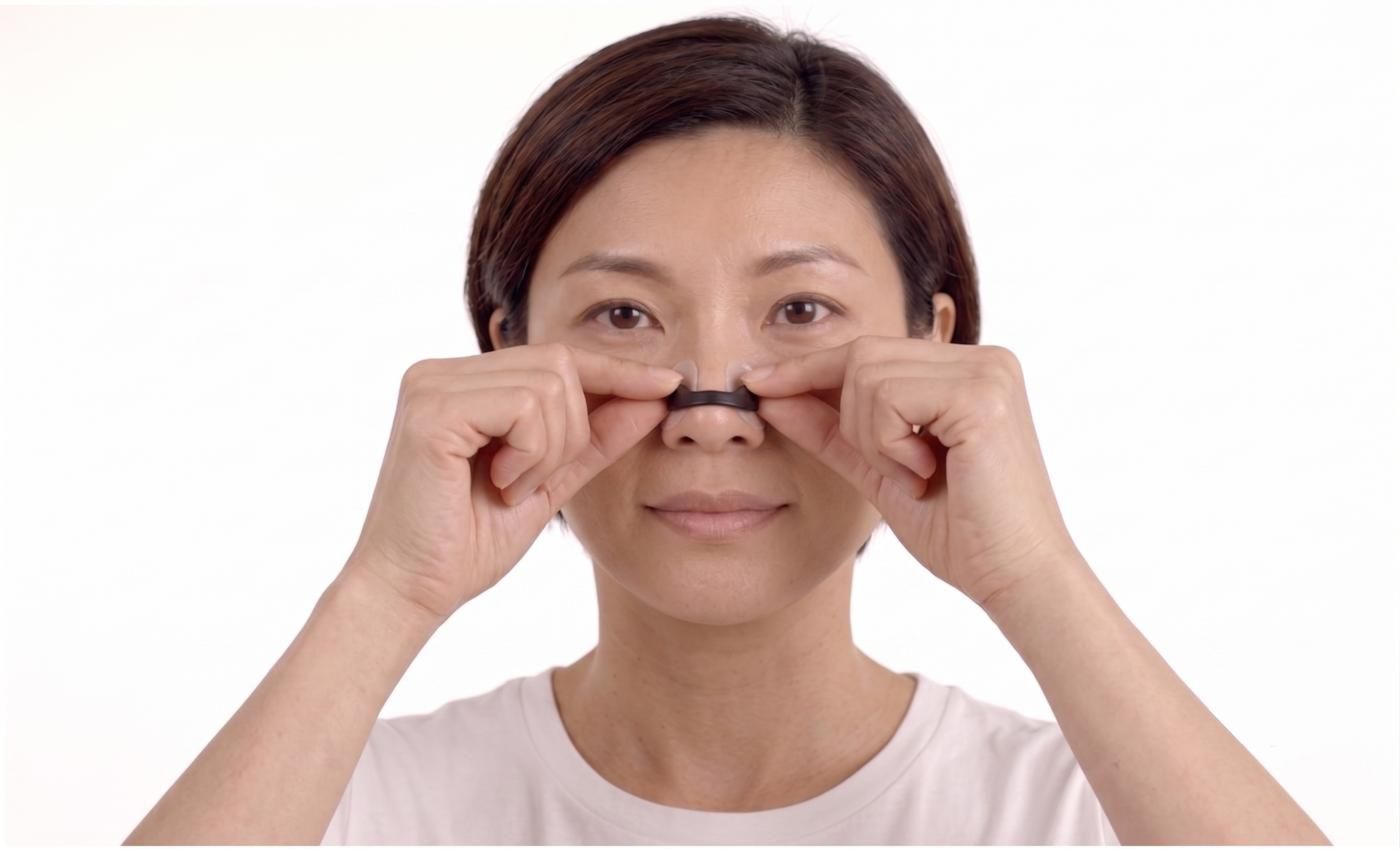
Sleep apnoea is when your breathing stops and starts while you sleep, and the most common type is obstructive sleep apnoea, according to the NHS. A nasal strip is an adhesive band across the outside of the nose that holds the nostrils open. "Nasal dilator" covers the wider family: strips, clips and small devices worn inside the nostrils.
Two reviews have pooled the research. A 2016 review of 14 studies found nasal dilators didn't improve sleep apnoea, and strips made no significant difference to snoring measured in sleep labs.[1] A 2026 review of 17 studies (496 people) found nasal dilators made no significant difference to snoring or sleep apnoea measured in sleep labs.[2] Our science page lists the studies behind nasal dilators.
| Who took part | What was compared | What changed | |
|---|---|---|---|
| 2016 review | 14 studies | Nasal strips and dilators worn inside the nose | No improvement in sleep apnoea |
| 2026 review | 17 studies, 496 people | Nasal dilators against controls | No significant difference in sleep apnoea or lab-measured snoring |
| 2012 trial | 12 people with acromegaly (a hormone condition) and moderate to severe sleep apnoea | Three months of CPAP and three months of strips | CPAP lowered breathing interruptions; strips didn't |
| 2017 trial | 26 people with severe sleep apnoea | Strips against CPAP | Strips made no difference to any sleep-lab measure |
| 2016 review | 11 studies of clearing a blocked nose | Sleep before and after the nose was cleared, by surgery or other means | Usually no improvement in sleep apnoea itself |
Strips have been the placebo in CPAP trials
CPAP (continuous positive airway pressure) is a machine that blows a steady supply of air through a mask to stop your airway closing while you sleep, as NHS inform explains. When researchers test it, they need a comparison that looks like a real option but shouldn't change the result.
Nasal strips have been used as the placebo in sleep apnoea research: in a 2012 trial of 12 people, CPAP lowered breathing interruptions and strips didn't.[3] Everyone in that trial also had acromegaly, a hormone condition. People's symptoms improved with both, though more with CPAP, while the sleep-lab measurements didn't change with strips. The researchers called that compatible with a placebo effect.[3]
Strips were the placebo again in a 2017 trial of 26 people with severe sleep apnoea, and they made no difference to any sleep-lab measure.[4]
Why opening the nose isn't enough
NHS inform describes obstructive sleep apnoea as the walls of the throat relaxing and narrowing or closing during sleep. A strip or clip works on the outside of the nose, at the front. It doesn't reach the throat.
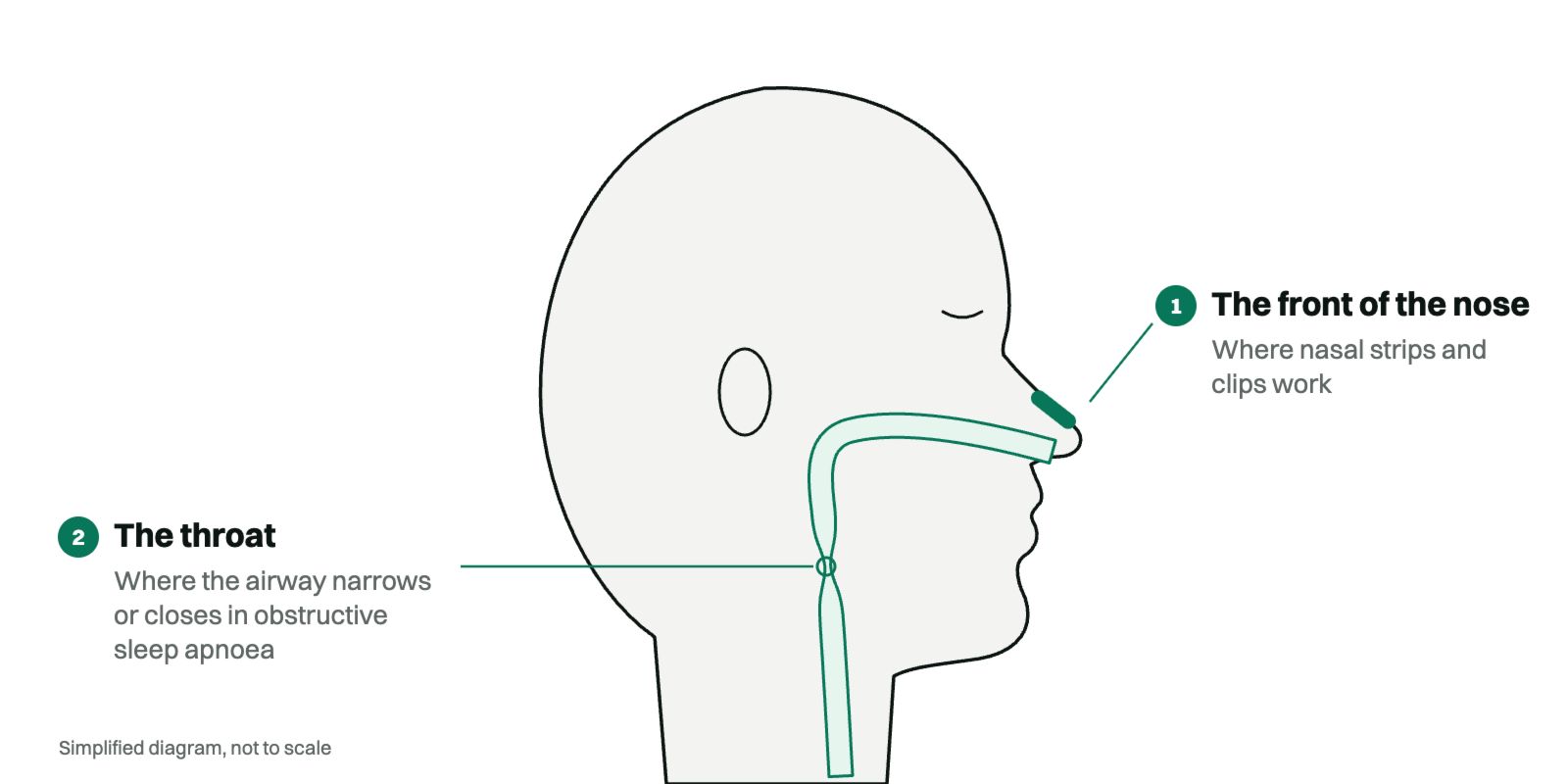
The nose still plays a part. A 2026 review found that when the nose is blocked, for example by packing after surgery, breathing interruptions during sleep increase.[5] But the reverse doesn't follow. A 2016 review of 11 studies found that clearing a blocked nose usually didn't improve sleep apnoea itself.[6]
What about magnetic nasal strips?
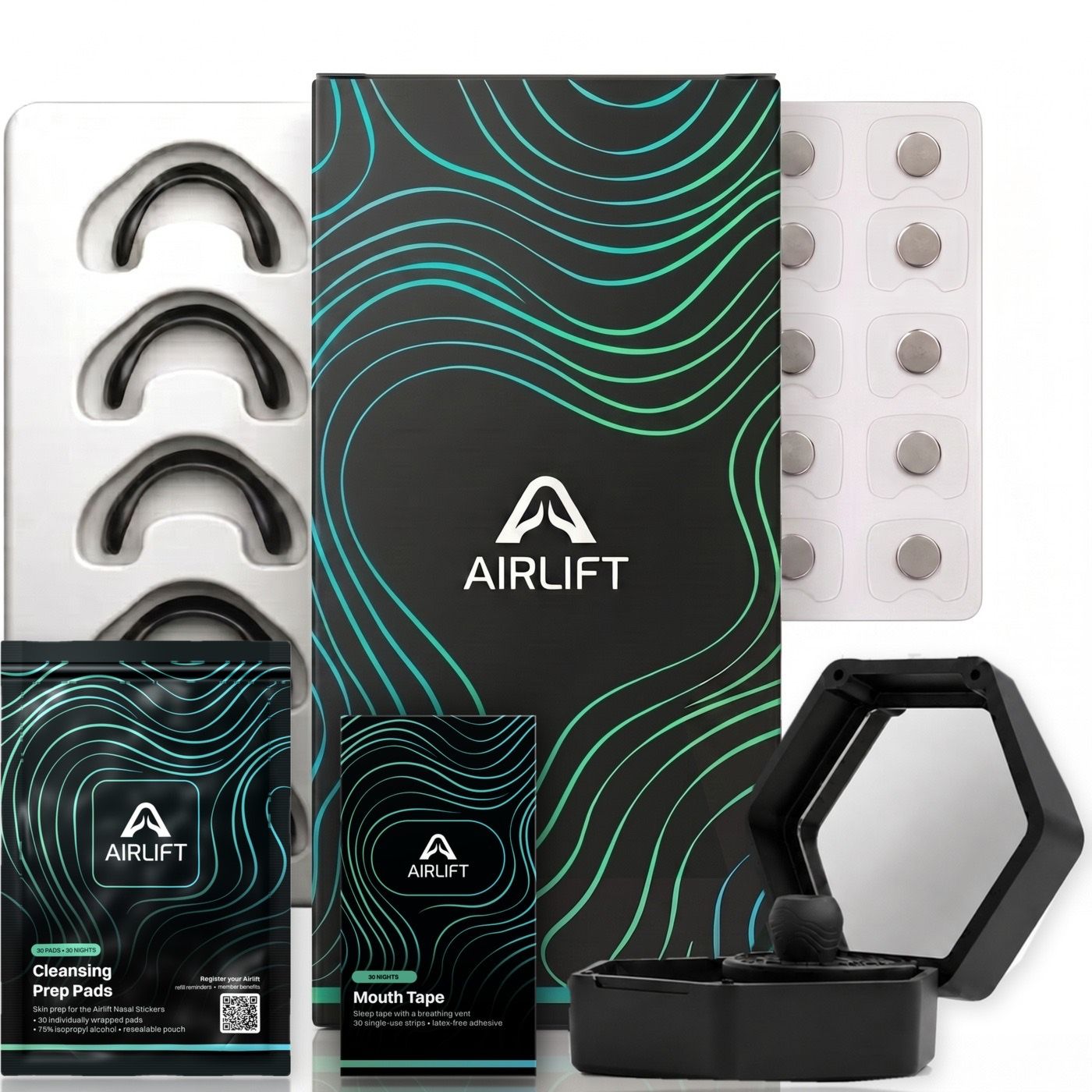
Magnetic strips also work from the outside of the nose. We could find no published, independent study of any magnetic nasal dilator, including Airlift's. A 2026 review by UK surgeons reached the same conclusion.[7] So there's no study of one in sleep apnoea either. Do magnetic nasal strips work? covers what is and isn't known about them.
Can you use nasal strips with a CPAP machine?
If you use CPAP, keep using it exactly as prescribed. A strip or clip isn't a substitute for it. Whether one fits alongside it depends on your mask, which is covered below.
People on CPAP often ask because a blocked nose is a known side effect. NHS inform lists nasal congestion, a runny nose or irritation, and difficulty breathing through your nose among the possible side effects of CPAP.
What the research says
Studies disagree on whether a blocked nose makes CPAP harder to stick with: some found people with more nasal resistance were more likely to give up early, while a 2021 trial of 317 people found no link.[8][9][10] Nasal resistance is how hard it is to move air through the nose.
A 2015 review of 18 studies found that after nose surgery, people with sleep apnoea needed lower CPAP pressures, and in the small number with device records, used their machines for longer each night.[11] That review covered surgery, not strips or clips.
In a 2003 one-night study of 38 CPAP users, a dilator worn inside the nostrils slightly lowered the air pressure their machines needed. We found no trial of external nasal strips used with CPAP.[12] So we found no published evidence on what an external strip or clip does for someone using CPAP.
Will a clip fit under your mask?
That depends on the mask. Here is Airlift's guidance for its own clip, from its help page. Other dilators will differ.
| Nasal pillows | Nasal mask | Full-face mask | |
|---|---|---|---|
| Room for an external clip | Usually: it sits below and outside where the cushion seals | Usually, for most nasal masks | Depends where the mask's edge lands; some press on the clip |
Nasal strips or CPAP?
They aren't alternatives. In the 2012 trial, CPAP lowered breathing interruptions and strips didn't.[3] NICE's guideline on sleep apnoea (NG202, 2021) recommends lifestyle advice for everyone with the condition, CPAP when symptoms affect daily life, and a custom-made or partly custom-made mouth splint for people who can't get on with CPAP or don't want it.[13] The guideline doesn't mention nasal dilators or strips.
Snoring without sleep apnoea is a different question
Snoring on its own is common. A 2019 survey of 1,239 UK adults found that 38% of men and 30% of women snore.[14] The NHS says snoring is very common and isn't usually caused by anything serious.
The NHS lists nasal dilators or strips that hold the nose open as one option when snoring is linked to a blocked or narrow nose. The page lists options and doesn't grade the evidence for them. Studies of strips for snoring are mixed and mostly found no measured change.[1][2] Our guide to nasal strips for snoring goes through them one by one.
If a blocked nose at night is part of the picture, why you mouth breathe at night covers the common reasons.
The signs of sleep apnoea and the NHS route
The NHS says to see a GP if your breathing stops and starts while you sleep, you make gasping, snorting or choking noises, or you always feel very tired during the day. If someone else has seen it happen, it can help to bring them with you.

- See your GPDescribe what happens at night and how you feel in the day. If a partner or someone else has seen the symptoms, the NHS suggests bringing them along.
- A referral to a sleep clinicIf your GP thinks you might have sleep apnoea, they may refer you to a specialist sleep clinic for tests.
- An overnight testThe clinic may give you devices that check things like your breathing and heartbeat while you sleep. You can usually wear them at home, though sometimes you'll need to stay at the clinic overnight.
- What the clinic may suggestLifestyle changes such as losing weight, stopping smoking and drinking less alcohol can sometimes help. Many people need a CPAP machine, which you'll be given free on the NHS if you need it. A device like a gum shield that holds the airway open is another option.
There's no recent measured figure for how common sleep apnoea is in the UK. One of the few UK studies to measure sleep apnoea directly, published in 1991, found severe sleep apnoea with symptoms in 3 of 1,001 men aged 35 to 65 from one Oxford practice, using the stricter definitions of the time.[15] It covered men only, from one practice, decades ago, so it isn't a current UK figure.
Driving
You may need to tell the DVLA about sleep apnoea. GOV.UK sets out when on its page about excessive sleepiness and driving.
Questions people ask
References
- Camacho M, Malu OO, Kram YA, Nigam G, Riaz M, Song SA, Tolisano AM, Kushida CA (2016). Nasal dilators (Breathe Right strips and NoZovent) for snoring and OSA: a systematic review and meta-analysis. Pulmonary Medicine, 2016, 4841310. doi.org/10.1155/2016/4841310
- Alotaibi S, Bin Saddiq BW, Alfarhoud RS, Alghamdi MTN, Alsaffar AJ, Alnabhan AM, Alkhateeb MA, Albahrani KH, Alowibidy SA, Almahdi ZI, Almaghrabi HA, Alnabulsi M (2026). Clinical effectiveness of nasal dilators in sleep-disordered breathing: a systematic review and meta-analysis. Cureus, 18(1), e100663. doi.org/10.7759/cureus.100663
- Amaro AC, Duarte FH, Jallad RS, Bronstein MD, Redline S, Lorenzi-Filho G (2012). The use of nasal dilator strips as a placebo for trials evaluating continuous positive airway pressure. Clinics (Sao Paulo), 67(5), 469-474. doi.org/10.6061/clinics/2012(05)11
- Yagihara F, Lorenzi-Filho G, Santos-Silva R (2017). Nasal dilator strip is an effective placebo intervention for severe obstructive sleep apnea. Journal of Clinical Sleep Medicine, 13(2), 215-221. doi.org/10.5664/jcsm.6450
- Alshehri NA, Alsaif NF, Abdulrazaq AN, Jabor RM, Al-Sayed AA (2026). Impact of nasal obstruction and mouth taping on sleep apnea indicators: systematic review and meta-analysis. OTO Open, 10(3), e70294. doi.org/10.1002/oto2.70294
- Migueis DP, Thuler LC, Lemes LN, Moreira CS, Joffily L, Araujo-Melo MH (2016). Systematic review: the influence of nasal obstruction on sleep apnea. Brazilian Journal of Otorhinolaryngology, 82(2), 223-231. doi.org/10.1016/j.bjorl.2015.05.018
- Ahmed A, Gakpetor C, Yang D, Oremule B, Ranganathan B, Jaiswal A, Bhalla RK (2026). The effectiveness of nonsurgical nasal devices in relieving nasal obstruction. Annals of the Royal College of Surgeons of England, 108(6), 476-483. doi.org/10.1308/rcsann.2025.0103
- Sugiura T, Noda A, Nakata S, et al. (2007). Influence of nasal resistance on initial acceptance of continuous positive airway pressure in treatment for obstructive sleep apnea syndrome. Respiration, 74(1), 56-60. doi.org/10.1159/000089836
- Inoue A, Chiba S, Matsuura K, Osafune H, Capasso R, Wada K (2019). Nasal function and CPAP compliance. Auris Nasus Larynx, 46(4), 548-558. doi.org/10.1016/j.anl.2018.11.006
- Sunderram J, Ayappa I, Lu SE, et al. (2021). PAP adherence and nasal resistance. A randomized controlled trial of CPAPflex versus CPAP in World Trade Center responders. Annals of the American Thoracic Society, 18(4), 668-677. doi.org/10.1513/AnnalsATS.202009-1161OC
- Camacho M, Riaz M, Capasso R, Ruoff CM, Guilleminault C, Kushida CA, Certal V (2015). The effect of nasal surgery on continuous positive airway pressure device use and therapeutic treatment pressures: a systematic review and meta-analysis. Sleep, 38(2), 279-286. doi.org/10.5665/sleep.4414
- Schönhofer B, Kerl J, Suchi S, Köhler D, Franklin KA (2003). Effect of nasal valve dilation on effective CPAP level in obstructive sleep apnea. Respiratory Medicine, 97(9), 1001-1005. doi.org/10.1016/s0954-6111(03)00125-2
- National Institute for Health and Care Excellence (2021). Obstructive sleep apnoea/hypopnoea syndrome and obesity hypoventilation syndrome in over 16s (NICE guideline NG202). www.nice.org.uk/guidance/ng202
- Lechner M, Breeze CE, Ohayon MM, Kotecha B (2019). Snoring and breathing pauses during sleep: interview survey of a United Kingdom population sample reveals a significant increase in the rates of sleep apnoea and obesity over the last 20 years - data from the UK sleep survey. Sleep Medicine, 54, 250-256. doi.org/10.1016/j.sleep.2018.08.029
- Stradling JR, Crosby JH (1991). Predictors and prevalence of obstructive sleep apnoea and snoring in 1001 middle aged men. Thorax, 46(2), 85-90. doi.org/10.1136/thx.46.2.85

Written by Nicholas Green
I've found it hard to breathe through my nose for as long as I can remember, and years of products and even surgery didn't fix it, so I built Airlift. I write about what I've learned along the way, as someone who lives with it rather than as a clinician.
How we research and check articles: our editorial standards.