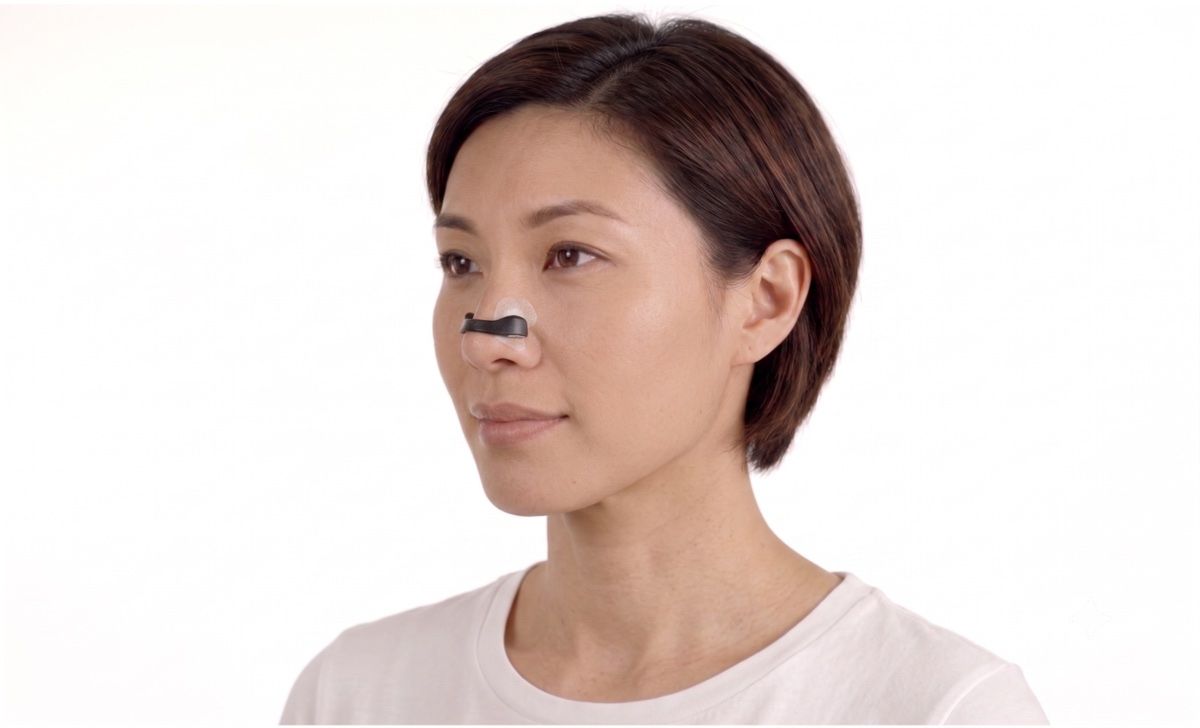

Nasal strips for a deviated septum can't straighten it. A strip or external dilator widens the front of the nose while worn, and in a 1998 lab study the effect was biggest in people with a deviated septum. We found no trial testing one over weeks. For lasting symptoms, the NHS route is your GP, then an ENT specialist.
In short
- A strip or clip works on the outside of the nose, at the front. It can't move the septum, which is the wall inside your nose.
- A bent septum is very common. ENT UK says many people with one have no blocked-nose symptoms, and that it does no harm, so you can leave it alone if you want to.
- In a UK trial of adults referred to NHS ENT clinics with a deviated septum, surgery improved symptoms more than nasal sprays at six months. The route is your GP, then an ENT specialist.
What nasal strips for a deviated septum can and can't do
They can't straighten it. A strip or clip sits on the outside of your nose, and the septum is inside it.
The nasal septum is the thin wall between your two nostrils, made of cartilage and bone, as ENT UK, the professional body for UK ear, nose and throat surgeons, describes it. When it's bent to one side, the inside of the nose can be narrower, often on one side, and feel blocked.
An external nasal dilator is a strip or clip worn across the outside of the nose that holds the sides of the nostrils open. Reviews describe external nasal dilators as working by widening the narrowest part of the nose and lowering resistance to airflow, while noting that most studies are small.[1]
Only one study we found has tested an external dilator in people with a bent septum. In a 1998 lab study, an external nasal dilator widened the nose and lowered airflow resistance in 28 people with a deviated septum, with the biggest effect in that group, but only while it was worn and only on the day tested.[2]
We found no trial of an external dilator or strip changing symptoms over days or weeks in people with a deviated septum, and no published, independent study of a magnetic one.[3]
ENT UK's blocked nose leaflet does mention strips. It suggests an adhesive dilating strip, particularly at night, when the blockage comes from collapse of the outside of the nasal tip. That's a different problem from a bent septum. Our guide to strip alternatives makes the same point about the septum.
How common is a deviated septum?
Very common, though most of the figures count bends rather than symptoms. ENT UK says many people with a twisted septum have no blocked-nose symptoms at all.
A bend in the septum is normal: a 1970s study of more than 2,000 adult skulls found only about one in five septa were straight.[4] In a study of 2,589 ENT patients in 14 countries, nearly nine in ten had some bend or spur in the septum.[5] In a Korean national health survey (2008 to 2012) in which doctors examined people's noses with an endoscope, about half had a deviated septum, and it became more common with age.[6]
| Who was examined | What they found | Caveat | |
|---|---|---|---|
| Gray 1978 | 2,112 adult skulls | About one in five septa straight | Old methods, skulls only |
| Mladina 2008 | 2,589 ENT patients in 14 countries | Nearly nine in ten had some bend or spur | ENT patients, not the public |
| Ahn 2016 | Korean national health survey with endoscopes | About half had a deviated septum, more common with age | Korean data |
We couldn't find a UK figure.
Where is your narrowing?
A strip can only reach narrowing at the front of the nose, so it matters where yours is.
An external dilator pulls on the outer side walls, near the nostrils. A bend in the septum can sit at the front of the nose or further back, out of a strip's reach. ENT UK's blocked nose leaflet names three causes of a blocked nose: a twisted septum, weakness of the outside of the nose, and swelling of the lining inside it. One person can have more than one.
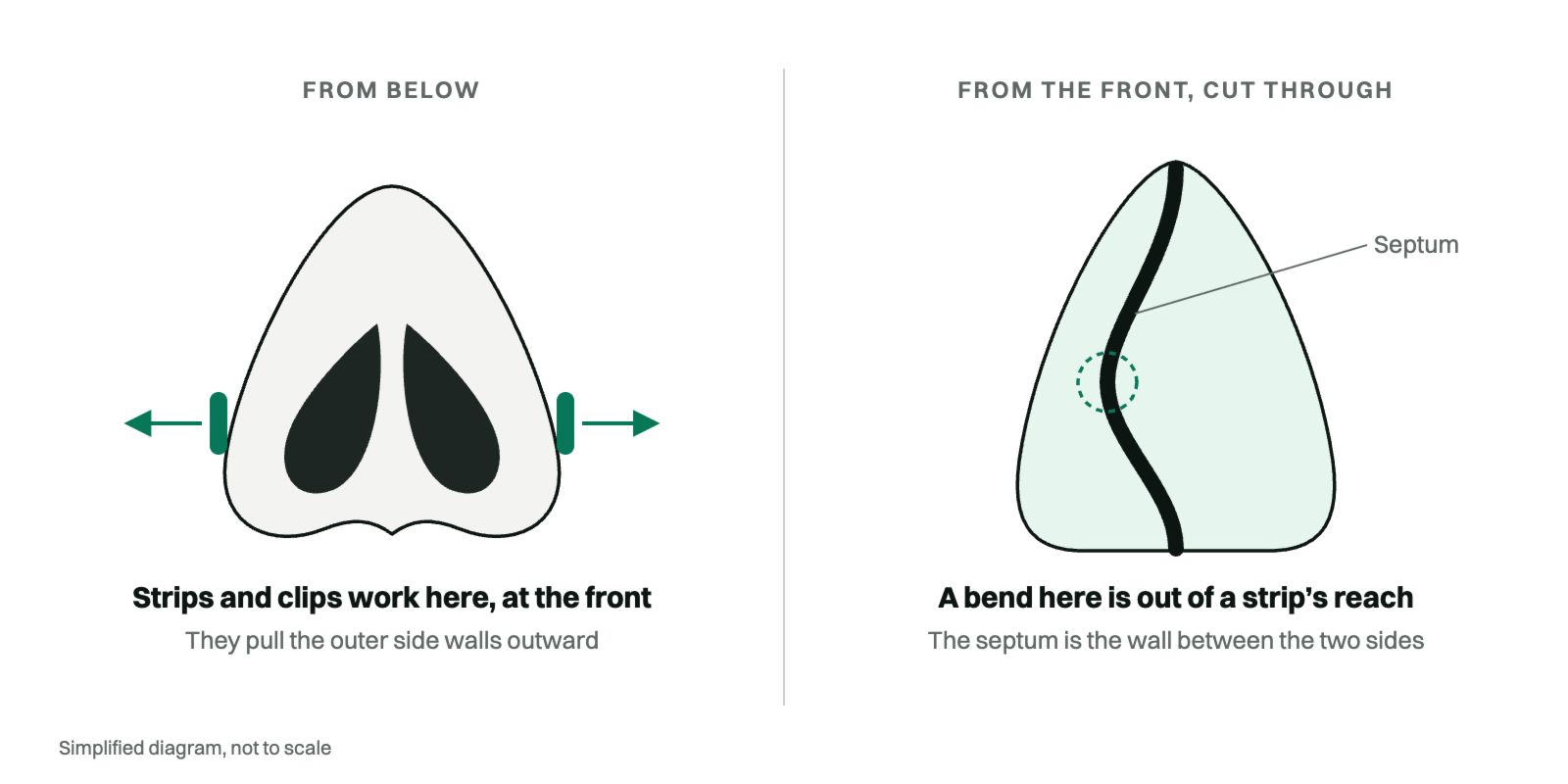
A description alone can't tell you which you have, but an examination can. For problems at the nasal valve, the narrow part just inside the nostrils, a 2026 review found there's still no single agreed test, and that breathing-flow tests are more reliable than a doctor's hands-on check alone.[7] Our article on nasal valve collapse explains that part of the nose in more detail.
Does the type of dilator matter?
We found no study comparing types of dilator in people with a deviated septum.
In general, the evidence leans towards devices worn inside the nose. A 2026 review by UK surgeons found most research is on adhesive strips, and that devices worn inside the nostril tended to perform better than external ones.[3] That review covered a blocked nose in general, not a bent septum. Our science page lists the studies behind nasal dilators.
We could find no published, independent study of any magnetic nasal dilator, including Airlift's. A 2026 review by UK surgeons reached the same conclusion.[3]
If you're weighing up formats, magnetic vs adhesive nasal strips compares how they're worn, and do magnetic nasal strips work? covers the evidence on magnetic ones.
The NHS route if your nose stays blocked
Start with your GP. ENT UK says to contact your GP if your symptoms are troublesome and persistent, and a GP can refer you to an ENT clinic.

ENT UK's septal surgery leaflet sets out the options an ENT specialist may discuss. Steroid spray or drops can bring down swelling inside the nose, which might improve the blockage. Septoplasty is the operation to straighten the septum, though ENT UK says surgery doesn't always improve symptoms. And because a bent septum does you no harm, leaving it alone is also a choice.
In a UK trial of 378 adults referred to NHS ENT clinics with a deviated septum, people who had surgery to straighten it reported much bigger improvements after six months than those using steroid and saline sprays.[8] Surgery has risks: in the same trial, about 4% of those operated on went back to hospital with bleeding, and 12% needed antibiotics for an infection.[8]
The wider evidence agrees. Three randomised trials, including this one, pooled in a 2025 review, found that for adults with troublesome symptoms from a deviated septum, surgery improved symptoms more than non-surgical care at 6 and 12 months.[9][10]
- See your GPExplain how long your nose has been blocked, which side, and how it affects your sleep, exercise or daily life.
- A referral to an ENT clinicIf your symptoms are troublesome and persistent, your GP can refer you to an ear, nose and throat specialist.
- An examinationThe specialist looks inside your nose to see where the narrowing is and what's causing it.
- The options ENT may discussSteroid spray or drops for swelling inside the nose, septoplasty to straighten the septum, or leaving it alone.
Questions people ask
References
- Dinardi RR, de Andrade CR, Ibiapina CdC (2014). External nasal dilators: definition, background, and current uses. International Journal of General Medicine, 7, 491-504. doi.org/10.2147/IJGM.S67543
- Roithmann R, Chapnik J, Cole P, Szalai J, Zamel N (1998). Role of the external nasal dilator in the management of nasal obstruction. Laryngoscope, 108(5), 712-715. doi.org/10.1097/00005537-199805000-00016
- Ahmed A, Gakpetor C, Yang D, Oremule B, Ranganathan B, Jaiswal A, Bhalla RK (2026). The effectiveness of nonsurgical nasal devices in relieving nasal obstruction. Annals of the Royal College of Surgeons of England, 108(6), 476-483. doi.org/10.1308/rcsann.2025.0103
- Gray LP (1978). Deviated nasal septum. Incidence and etiology. Annals of Otology, Rhinology and Laryngology Supplement, 87(3 Pt 3 Suppl 50), 3-20. doi.org/10.1177/00034894780873s201
- Mladina R, Cujić E, Subarić M, Vuković K (2008). Nasal septal deformities in ear, nose, and throat patients: an international study. American Journal of Otolaryngology, 29(2), 75-82. doi.org/10.1016/j.amjoto.2007.02.002
- Ahn JC, Kim JW, Lee CH, Rhee CS (2016). Prevalence and risk factors of chronic rhinosinusitus, allergic rhinitis, and nasal septal deviation: results of the Korean National Health and Nutrition Survey 2008-2012. JAMA Otolaryngology Head and Neck Surgery, 142(2), 162-167. doi.org/10.1001/jamaoto.2015.3142
- Daoud M, Gherasie LM, Fufezan ML, Hainăroșie R, Voiosu C, Rusescu A, Ioniță IG, Aliuș OR, Zainea V (2026). Diagnostic approaches and surgical outcomes in nasal valve dysfunction: a systematic review. Diagnostics (Basel), 16(9), 1324. doi.org/10.3390/diagnostics16091324
- Carrie S, O'Hara J, Fouweather T, et al. (2023). Clinical effectiveness of septoplasty versus medical management for nasal airways obstruction: multicentre, open label, randomised controlled trial. BMJ, 383, e075445. doi.org/10.1136/bmj-2023-075445
- Taha HI, Elgendy MS, Ezz MR, et al. (2025). Septoplasty versus non-surgical management for deviated nasal septum: a systematic review and meta-analysis of randomized controlled trials. European Archives of Oto-Rhino-Laryngology, 282(2), 597-610. doi.org/10.1007/s00405-024-08937-x
- van Egmond MMHT, Rovers MM, Hannink G, Hendriks CTM, van Heerbeek N (2019). Septoplasty with or without concurrent turbinate surgery versus non-surgical management for nasal obstruction in adults with a deviated septum: a pragmatic, randomised controlled trial. Lancet, 394(10195), 314-321. doi.org/10.1016/S0140-6736(19)30354-X

Written by Nicholas Green
I've found it hard to breathe through my nose for as long as I can remember, and years of products and even surgery didn't fix it, so I built Airlift. I write about what I've learned along the way, as someone who lives with it rather than as a clinician.
How we research and check articles: our editorial standards.