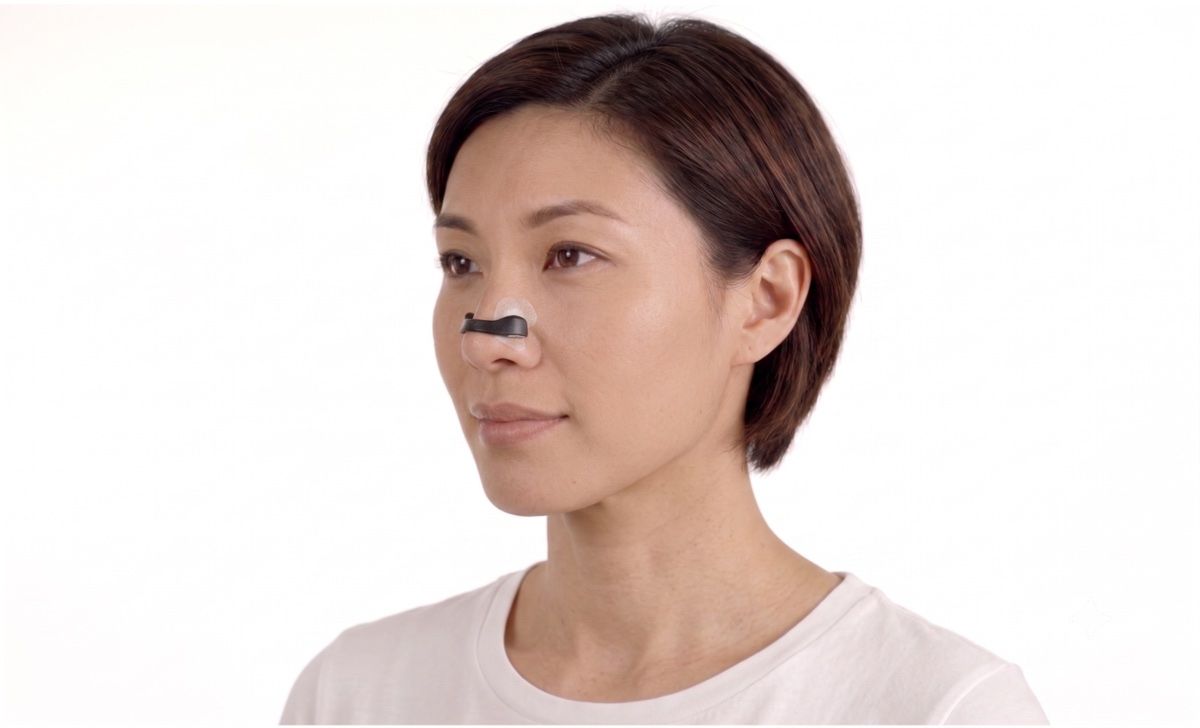

Nasal valve collapse is a narrowing at the nasal valve, the narrowest part of the airway inside the nose, where external nasal dilators act. There's no single agreed test: a common cheek-pull check made breathing feel easier for 97 of 100 healthy volunteers. A US expert panel said nasal dilators may help some people, with surgery the main option.
In short
- Nasal valve collapse is a narrowing at the nasal valve, the narrowest part of the airway inside your nose.
- There's no single agreed test, and the cheek-pull check people try at home feels positive for almost everyone, so on its own it tells you little.
- In one study, two in three people with valve problems wanted to keep using a nasal dilator after a month and the other third stopped, and dilators worn inside the nose raised airflow more than external ones. A US expert panel calls surgery the main option.
What is nasal valve collapse?
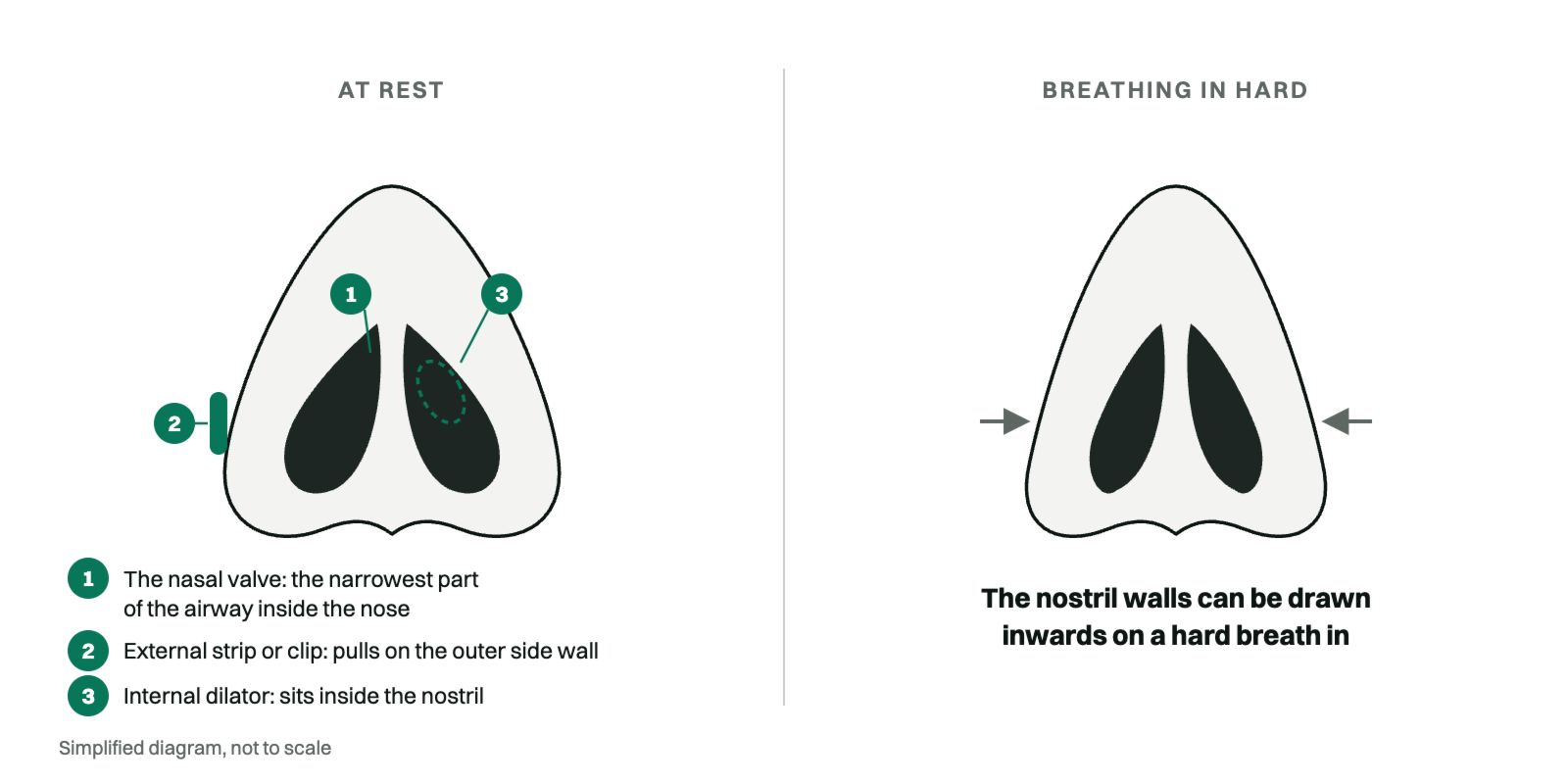
Nasal valve collapse is a narrowing at the nasal valve, the narrowest part of the airway inside the nose, where external nasal dilators act.[1]
Reviews describe external nasal dilators as working by widening the narrowest part of the nose and lowering resistance to airflow, while noting that most studies are small.[1] Our science page lists the studies behind nasal dilators.
A hard breath in can draw the nostril walls inwards. In a 1999 lab study of 20 adults, a nasal strip raised peak airflow when breathing in hard through the nose by about 12%, by stopping the nostril walls being drawn inwards.[10] The volunteers were healthy and were tested awake.
It's one of several reasons a nose can feel blocked. ENT UK, the professional body for UK ear, nose and throat surgeons, names three in its 2021 blocked nose leaflet, currently marked as under review: a twisted septum, weakness of the outside of the nose, and swelling of the lining inside it. ENT UK doesn't use the term nasal valve, but its leaflet lists weakness of the outside of the nose as one cause.
We couldn't find a UK or general-population figure for how common it is. Part of the reason is that a common way of checking for it is unreliable on its own, as the next section explains.
Can you test for nasal valve collapse at home?
Not reliably. A common hands-on check, called the Cottle manoeuvre, means pulling the cheek sideways beside the nose to see whether breathing gets easier. It's taught on plenty of websites as a self-test, but it feels positive for almost everyone.
A positive result didn't predict much in patients either. A 2018 study of 141 people having nose surgery found the result of the Cottle test made no difference to how much their symptoms improved a year later.[3]
A 2026 review found there's still no single agreed test for nasal valve problems, and that breathing-flow tests are more reliable than a doctor's hands-on check alone.[4]
Some surgeons use a nasal strip as a quick test: in a 2011 series of 30 people, where on the nose a strip helped matched which part of the valve needed surgery in 27 of them.[5] That was a surgeon's check in clinic, alongside an examination, before an operation, so it isn't a test you can do at home with a strip.
Do nasal dilators help nasal valve collapse?
The evidence is small: we found one month-long study of dilators in people with valve problems, and one small study in athletes.
In a 2016 study of 100 people with nasal valve problems, two in three wanted to keep using a nasal dilator after a month's trial, and dilators worn inside the nose improved airflow more than external ones. The others stopped because of irritation, poor fit or too little relief.[6] The study had no dummy device to compare against.
A 2010 US expert consensus said nasal dilators may help some people with nasal valve problems, but that surgery is the main option.[7] In the UK, ENT UK's blocked nose leaflet suggests an adhesive dilating strip, particularly at night, when the blockage comes from collapse of the outside of the nasal tip.
Two more findings lean towards devices worn inside the nose. In a 2024 study of 38 endurance athletes, an internal nasal dilator improved breathing and aerobic test results only in those who had a narrowing at the nasal valve.[8] That was an internal device, in athletes, with no dummy device for comparison. And a 2026 review by UK surgeons found most research is on adhesive strips, and that devices worn inside the nostril tended to perform better than external ones.[9]

We could find no published, independent study of any magnetic nasal dilator, including Airlift's. A 2026 review by UK surgeons reached the same conclusion.[9]
| Adhesive strip | Magnetic clip with stickers | Internal dilator or cone | |
|---|---|---|---|
| Where it works | Outside, pulling the side walls outward | Outside, a clip pulls stickers on the side walls outward | Inside the nostril, holding it open |
| Reused? | No, single use | Clip reused, stickers single use | Yes, for a period that depends on the brand |
| Studies in people with valve problems | Lekakis 2016 tested external dilators (types not given in the abstract) | None published | Lekakis 2016 (raised airflow more than external); Valsamidis 2024 (athletes) |
If you're comparing formats, magnetic vs adhesive nasal strips covers how they're worn, and do magnetic nasal strips work? covers the evidence on magnetic ones. For how internal and external dilators differ in use, see nasal strips vs nasal dilators.
Surgery and the NHS route
If your nose is blocked most of the time, start with your GP, who can refer you to an ENT specialist. ENT UK says to contact your GP if your symptoms are troublesome and persistent.
The NHS doesn't have a page on nasal valve collapse, so ENT UK's 2021 leaflet, currently marked as under review, is the closest UK clinical guidance we found. The 2010 US consensus above calls surgery the main option.[7]
A twisted septum is the other structural cause ENT UK names, and it's a different problem. Nasal strips for a deviated septum covers that one.
- See your GPExplain how long your nose has been blocked, whether it's worse on one side or when you breathe in hard, and how it affects your sleep or daily life.
- A referral to ENTIf your symptoms are troublesome and persistent, your GP can refer you to an ear, nose and throat specialist.
- An examinationThe specialist looks at where your nose narrows. This may include breathing-flow tests, which a 2026 review found more reliable than a hands-on check alone.
- The options ENT may discussDepending on what the examination finds, these may include a nasal dilator for some people, or surgery.
Questions people ask
References
- Dinardi RR, de Andrade CR, Ibiapina CdC (2014). External nasal dilators: definition, background, and current uses. International Journal of General Medicine, 7, 491-504. doi.org/10.2147/IJGM.S67543
- Das A, Spiegel JH (2020). Evaluation of validity and specificity of the Cottle maneuver in diagnosis of nasal valve collapse. Plastic and Reconstructive Surgery, 146(2), 277-280. doi.org/10.1097/PRS.0000000000006978
- Bonaparte JP, Campbell R (2018). A prospective cohort study assessing the clinical utility of the Cottle maneuver in nasal septal surgery. Journal of Otolaryngology - Head and Neck Surgery, 47(1), 45. doi.org/10.1186/s40463-018-0292-9
- Daoud M, Gherasie LM, Fufezan ML, Hainăroșie R, Voiosu C, Rusescu A, Ioniță IG, Aliuș OR, Zainea V (2026). Diagnostic approaches and surgical outcomes in nasal valve dysfunction: a systematic review. Diagnostics (Basel), 16(9), 1324. doi.org/10.3390/diagnostics16091324
- Gruber RP, Lin AY, Richards T (2011). Nasal strips for evaluating and classifying valvular nasal obstruction. Aesthetic Plastic Surgery, 35(2), 211-215. doi.org/10.1007/s00266-010-9589-4
- Lekakis G, Dekimpe E, Steelant B, Hellings PW (2016). Managing nasal valve compromise patients with nasal dilators: objective vs. subjective parameters. Rhinology, 54(4), 348-354. doi.org/10.4193/Rhin16.192
- Rhee JS, Weaver EM, Park SS, Baker SR, Hilger PA, Kriet JD, Murakami C, Senior BA, Rosenfeld RM, DiVittorio D (2010). Clinical consensus statement: diagnosis and management of nasal valve compromise. Otolaryngology - Head and Neck Surgery, 143(1), 48-59. doi.org/10.1016/j.otohns.2010.04.019
- Valsamidis K, Printza A, Valsamidis N, Constantinidis J, Triaridis S (2024). Improvement of the aerobic performance in endurance athletes presenting nasal valve compromise with the application of an internal nasal dilator. American Journal of Otolaryngology, 45(1), 104059. doi.org/10.1016/j.amjoto.2023.104059
- Ahmed A, Gakpetor C, Yang D, Oremule B, Ranganathan B, Jaiswal A, Bhalla RK (2026). The effectiveness of nonsurgical nasal devices in relieving nasal obstruction. Annals of the Royal College of Surgeons of England, 108(6), 476-483. doi.org/10.1308/rcsann.2025.0103
- Di Somma EM, West SN, Wheatley JR, Amis TC (1999). Nasal dilator strips increase maximum inspiratory flow via nasal wall stabilization. Laryngoscope, 109(5), 780-784. doi.org/10.1097/00005537-199905000-00018

Written by Nicholas Green
I've found it hard to breathe through my nose for as long as I can remember, and years of products and even surgery didn't fix it, so I built Airlift. I write about what I've learned along the way, as someone who lives with it rather than as a clinician.
How we research and check articles: our editorial standards.