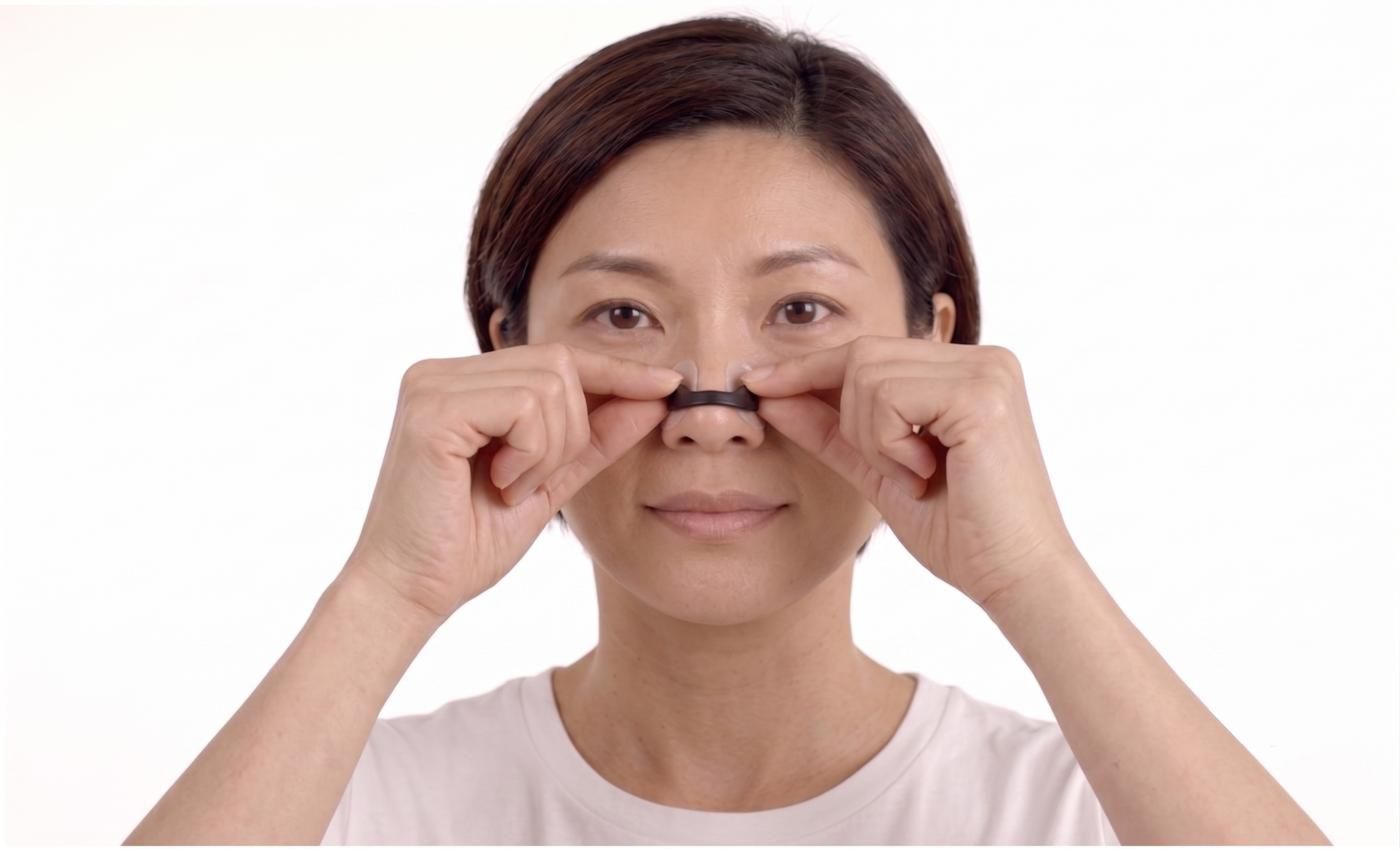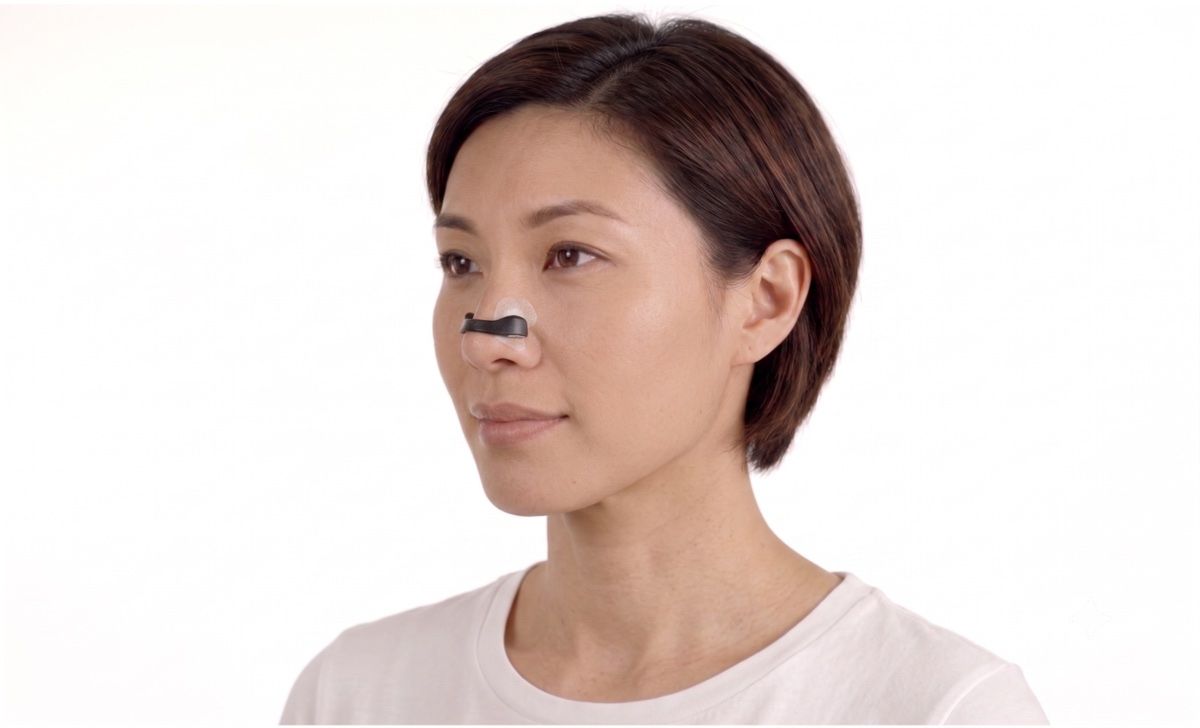

Why do athletes wear nasal strips? We found no survey that has asked them, so the best answer comes from research. A 2023 evidence guide by respiratory and exercise scientists concluded that strips may make breathing feel easier, but found no good evidence that they improve exercise performance. Carlos Alcaraz told reporters he wore one for a slight cold.
In short
- We found no survey that has asked athletes why they wear nasal strips. Players who have said why in interviews give reasons like a cold or breathing that feels easier.
- Research hasn't found a performance gain: a 2021 review of 19 studies found no change in VO2max, heart rate or how hard exercise felt in healthy people.
- Strips, internal dilators and magnetic clips all open the nostrils mechanically. A swimmer's nose clip does the opposite: it closes the nose.
Why do athletes wear nasal strips?
We found no survey that has asked athletes why they wear nasal strips. So the reasons we have come from two places: what players have told reporters, and what trials have measured.
An external nasal dilator is anything worn on the outside of the nose to hold the nostrils open, and an adhesive strip is the most common kind. Reviews describe external nasal dilators as working by widening the narrowest part of the nose and lowering resistance to airflow, while noting that most studies are small.[2] In a 1999 lab study of 20 adults, a nasal strip raised peak airflow when breathing in hard through the nose by about 12%, by stopping the nostril walls being drawn inwards.[3] That study was done at rest, in healthy people, and says nothing about sport.
In exercise, a 2023 evidence guide by respiratory and exercise scientists concluded that nasal strips may make breathing feel easier, but found no good evidence that they improve exercise performance.[1] That feeling is real to the wearer, but it isn't a measured change in performance.
Who's been seen wearing them?
Nasal strips have turned up on footballers, marathon runners and tennis players since the 1990s. These are three examples from independent press:
| Sport | Where it was reported | What was said | |
|---|---|---|---|
| Robbie Fowler | Football (Premier League) | Planet Football, August 2026 | Listed his nasal strips among the Premier League's most iconic accessories |
| Paula Radcliffe | Marathon | InsideHook, August 2021 | Named her as an early adopter of nasal strips |
| Carlos Alcaraz | Tennis | DPA news agency, March 2025 | He told reporters: "It's for my health. I have a slight cold and can breathe better this way." |
These are reports by the outlets named. Seeing a player wear a strip isn't evidence that it works, and none of these people has any connection with Airlift.
Do nasal strips improve athletic performance?
Not in the studies so far. The largest review found no change.
One later review leans the other way, with a heavy caveat. A 2022 review of 11 running studies reported results in favour of nasal dilators for VO2max and how hard running felt, but rated the certainty of that evidence as very low.[5] A 2021 review of 19 studies of nasal strips in sport found no benefit.[4]
| Who took part | What was tested | What changed | |
|---|---|---|---|
| Adams 2017, part-funded by Rhinomed | 15 trained cyclists | Internal dilator and nasal strip, 20 km time trial | No change in power |
| Schaeffer 2021, independent | 8 adults | Turbine internal dilator, cycling test | No change in breathlessness or peak performance |
| Pujol 1998 | 17 young adults | Nasal strip, steady 20-minute run | The run didn't feel any easier |
| Ottaviano 2017 | 13 triathletes | Nasal strips, breathing only through the nose | Kept going longer and breathing felt easier, but no dummy strip for comparison |
| Recinto 2017 and Lévénez 2025 | 9 and 49 adults | Nose-only vs mouth-only breathing, 30-second sprint | No change in power output |
In a 2017 trial part-funded by Rhinomed, neither an internal dilator nor a nasal strip changed 15 trained cyclists' power over a 20 km time trial.[6] An independent 2021 study of 8 adults found the Turbine internal dilator didn't change breathlessness or peak performance in a cycling test.[7] In a 1998 study of 17 young adults, wearing a nasal strip didn't make a steady 20-minute run feel any easier.[8] In a 2017 study of 13 triathletes, nasal strips let them keep going for longer when breathing only through the nose, and made breathing feel easier, but there was no dummy strip for comparison.[9] Two lab studies found breathing only through the nose didn't change power output in a 30-second sprint test.[10][11]
None of this covers magnetic strips. We could find no published, independent study of any magnetic nasal dilator, including Airlift's. A 2026 review by UK surgeons reached the same conclusion.[12] Results for adhesive strips can't be borrowed for magnetic ones. Our guide to whether magnetic nasal strips work goes through what is and isn't known, and our science page has more on the evidence.
One more positive exercise result is for an internal dilator in a specific group. In a 2024 study of 38 endurance athletes, an internal nasal dilator improved breathing and aerobic test results only in those who had a narrowing at the nasal valve.[13] It isn't evidence for adhesive strips or magnetic clips, and athletes without that narrowing saw no change.
Why do footballers wear nasal strips?
Footballers give the same kinds of reasons as other athletes, and the evidence is the same as above. The DPA news agency reported in March 2025 that countless footballers wore nose plasters in the 1990s, and that a host of footballers had brought them back. Planet Football counts Robbie Fowler's nasal strips among the Premier League's most iconic accessories.
On the rules, Law 4 of the Laws of the Game doesn't mention nasal strips. It says a player must not use or wear anything that is dangerous. Players are inspected before the match, and the referee must order a player to remove dangerous equipment. So whether a strip is allowed is the referee's call, within the competition's rules.
For contact play, Rhinomed says its Turbine internal dilator isn't for contact sports. Airlift publishes no guidance on contact sport, so we're not suggesting Airlift for a match.
Black nasal strips are mostly a look. On The Nose Co positions its black strips as its strongest hold for workouts, which is the brand's own description rather than a test result.
Why do runners wear nose strips?
Runners give the same reasons, and the running-specific evidence points the same way. In the 1998 study above, a strip didn't make a steady 20-minute run feel easier, and the two reviews covered earlier found no reliable gain.

Some runners are more interested in nose breathing itself, which is a separate question from wearing a strip. Here's what studies of nose-only breathing found:
- In a 2025 lab study of 12 healthy adults, breathing only through the nose during an all-out cycling test lowered peak oxygen uptake and workload and made the effort feel harder.[14]
- In a small 2018 study, 10 runners who had trained themselves to breathe only through the nose reached the same VO2max breathing through the nose as through the mouth.[15] Their VO2max didn't drop, and it didn't rise either.
- In a 2023 study of 19 fit adults, an hour of easy cycling breathing only through the nose was slightly less comfortable but didn't feel any harder, and they breathed less air for the same work.[16]
At hard efforts most people breathe through the mouth as well, and a strip doesn't change that. If you breathe through your mouth at night too, our guide to why you mouth breathe at night explains the common causes.
If you're choosing a strip for running, our best nasal strips for running guide compares them.
HYROX, tennis and the gym
HYROX racers wear strips for the same reasons, and HiStrips sells an official HYROX collaboration edition of its adhesive strips. That's a brand tie-in, not evidence. HYROX's Season 26/27 singles rulebook doesn't mention nasal strips and says items not on its permitted list need the Race Director's written permission, so check with your event before race day. Airlift has no connection with HYROX.
In tennis, Carlos Alcaraz is the best-known recent example, and his stated reason was a cold. In the gym, the same evidence applies, though the studies above tested running, cycling and sprint tests rather than gym training.

Nasal strips, internal dilators, magnetic clips and nose clips
These four are easy to confuse, and they work differently.
| Where it sits | What it does | Reusable? | |
|---|---|---|---|
| Adhesive strip | Across the bridge of the nose | A springy band lifts the sides of the nostrils outward | No, single use |
| Internal dilator such as Turbine | Just inside the nostrils | Holds the nostrils open from the inside | Yes, for a set number of uses (up to 10 for Turbine) |
| Magnetic clip such as Airlift | Two stickers on the sides of the nose, with a clip across the front | The clip attaches to the stickers and opens the nostrils from the sides | The clip is; the stickers are single use |
| Swimmer's nose clip | Pinches the nostrils | Closes the nose to keep water out | Depends on the product |
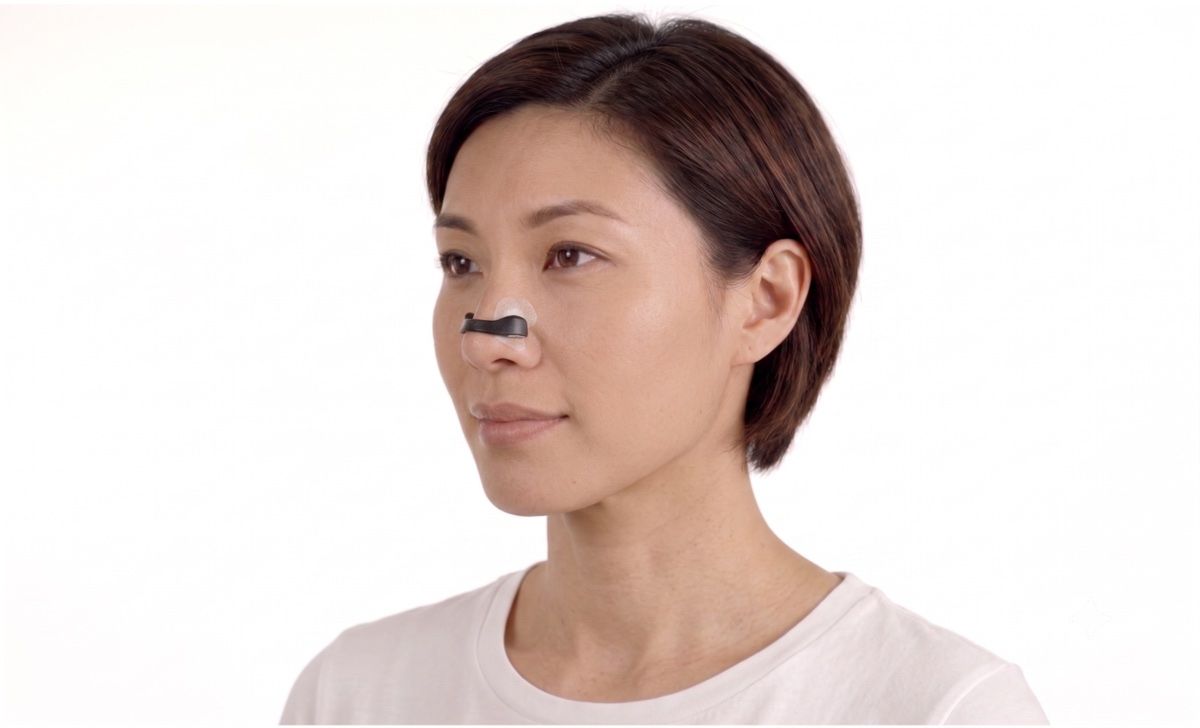
For the full comparison of formats, see our magnetic vs adhesive nasal strips guide. Our Airlift vs Mute comparison covers internal dilators.
Where Airlift fits
Airlift is a magnetic clip made for sleep first, and it has no sport version. We could find no published, independent study of Airlift, and nothing suggests it changes performance.
If you want to try one in training, Airlift's own advice on sizes for sleep and exercise is to take the smaller of two sizes for exercise and the larger for sleep. Its help page also says to take it off before swimming or a shower.
All five clip sizes come in the box, so you find your size at home. The Complete starter (£33) has the clip, 30 nights of stickers and 30 prep pads. Under the 90-Night Airlift Test, you can claim a full refund within 90 days of receiving your order, including delivery, without sending anything back; it's once per customer.
Airlift is a UK company, with UK delivery in pounds. Every subscription order ships free by next-day delivery, with no minimum spend. You can see the systems on the Airlift shop, and our guide to nasal strips for running compares Airlift with strips made for sport.
Questions people ask
References
- Illidi CR, Romer LM, Johnson MA, Williams NC, Rossiter HB, Casaburi R, Tiller NB (2023). Distinguishing science from pseudoscience in commercial respiratory interventions: an evidence-based guide for health and exercise professionals. European Journal of Applied Physiology, 123(8), 1599-1625. doi.org/10.1007/s00421-023-05166-8
- Dinardi RR, de Andrade CR, Ibiapina CdC (2014). External nasal dilators: definition, background, and current uses. International Journal of General Medicine, 7, 491-504. doi.org/10.2147/IJGM.S67543
- Di Somma EM, West SN, Wheatley JR, Amis TC (1999). Nasal dilator strips increase maximum inspiratory flow via nasal wall stabilization. Laryngoscope, 109(5), 780-784. doi.org/10.1097/00005537-199905000-00018
- Dinardi RR, Ferreira CHS, Silveira GS, de Araújo Silva VE, da Cunha Ibiapina C, de Andrade CR (2021). Does the external nasal dilator strip help in sports activity? A systematic review and meta-analysis. European Archives of Oto-Rhino-Laryngology, 278(5), 1307-1320. doi.org/10.1007/s00405-020-06202-5
- Gomes SKSP, Malaguti C, Elias Filho J, Caetano RO, da Silva CV, de Oliveira TMD, Hespanhol L, Felício DC (2022). Nasal dilator and physiological parameters associated to running performance: a systematic review and meta-analysis. Journal of Sports Sciences, 40(20), 2315-2326. doi.org/10.1080/02640414.2022.2151752
- Adams CM, Peiffer JJ (2017). Neither internal nor external nasal dilation improves cycling 20-km time trial performance. Journal of Science and Medicine in Sport, 20(4), 415-419. doi.org/10.1016/j.jsams.2016.08.018
- Schaeffer MR, McBride E, Mitchell RA, et al. (2021). Effects of the Turbine on ventilatory and sensory responses to incremental cycling. Medicine and Science in Sports and Exercise, 53(1), 192-199. doi.org/10.1249/MSS.0000000000002427
- Pujol TJ, Langenfeld ME, Hinojosa JR, Iman WH (1998). Effects of an external nasal dilator strip on differentiated ratings of perceived exertion. Perceptual and Motor Skills, 86(3 Pt 2), 1153-1154. doi.org/10.2466/pms.1998.86.3c.1153
- Ottaviano G, Ermolao A, Nardello E, Muci F, Favero V, Zaccaria M, Favero L (2017). Breathing parameters associated to two different external nasal dilator strips in endurance athletes. Auris Nasus Larynx, 44(6), 713-718. doi.org/10.1016/j.anl.2017.01.006
- Recinto C, Efthemeou T, Boffelli PT, Navalta JW (2017). Effects of nasal or oral breathing on anaerobic power output and metabolic responses. International Journal of Exercise Science, 10(4), 506-514. doi.org/10.70252/EHDR7442
- Lévénez M, Lévêque C, Lafère C, Guerrero F, Balestra C, Lafère P (2025). Effect of oral versus nasal breathing on muscular performance, muscle oxygenation, and post-exercise recovery. Sports (Basel), 13(10), 368. doi.org/10.3390/sports13100368
- Ahmed A, Gakpetor C, Yang D, Oremule B, Ranganathan B, Jaiswal A, Bhalla RK (2026). The effectiveness of nonsurgical nasal devices in relieving nasal obstruction. Annals of the Royal College of Surgeons of England, 108(6), 476-483. doi.org/10.1308/rcsann.2025.0103
- Valsamidis K, Printza A, Valsamidis N, Constantinidis J, Triaridis S (2024). Improvement of the aerobic performance in endurance athletes presenting nasal valve compromise with the application of an internal nasal dilator. American Journal of Otolaryngology, 45(1), 104059. doi.org/10.1016/j.amjoto.2023.104059
- Mapelli M, Salvioni E, Mattavelli I, et al. (2025). Nasal vs. oral BREATHing WIn Strategies in healthy individuals during cardiorespiratory Exercise testing (BreathWISE). PLoS One, 20(7), e0326661. doi.org/10.1371/journal.pone.0326661
- Dallam GM, McClaran SR, Cox DG, Foust CP (2018). Effect of nasal versus oral breathing on VO2max and physiological economy in recreational runners following an extended period spent using nasally restricted breathing. International Journal of Kinesiology and Sports Science, 6(2), 22. doi.org/10.7575/aiac.ijkss.v.6n.2p.22
- Rappelt L, Held S, Wiedenmann T, Deutsch JP, Hochstrate J, Wicker P, Donath L (2023). Restricted nasal-only breathing during self-selected low intensity training does not affect training intensity distribution. Frontiers in Physiology, 14, 1134778. doi.org/10.3389/fphys.2023.1134778

Written by Nicholas Green
I've found it hard to breathe through my nose for as long as I can remember, and years of products and even surgery didn't fix it, so I built Airlift. I write about what I've learned along the way, as someone who lives with it rather than as a clinician.
How we research and check articles: our editorial standards.