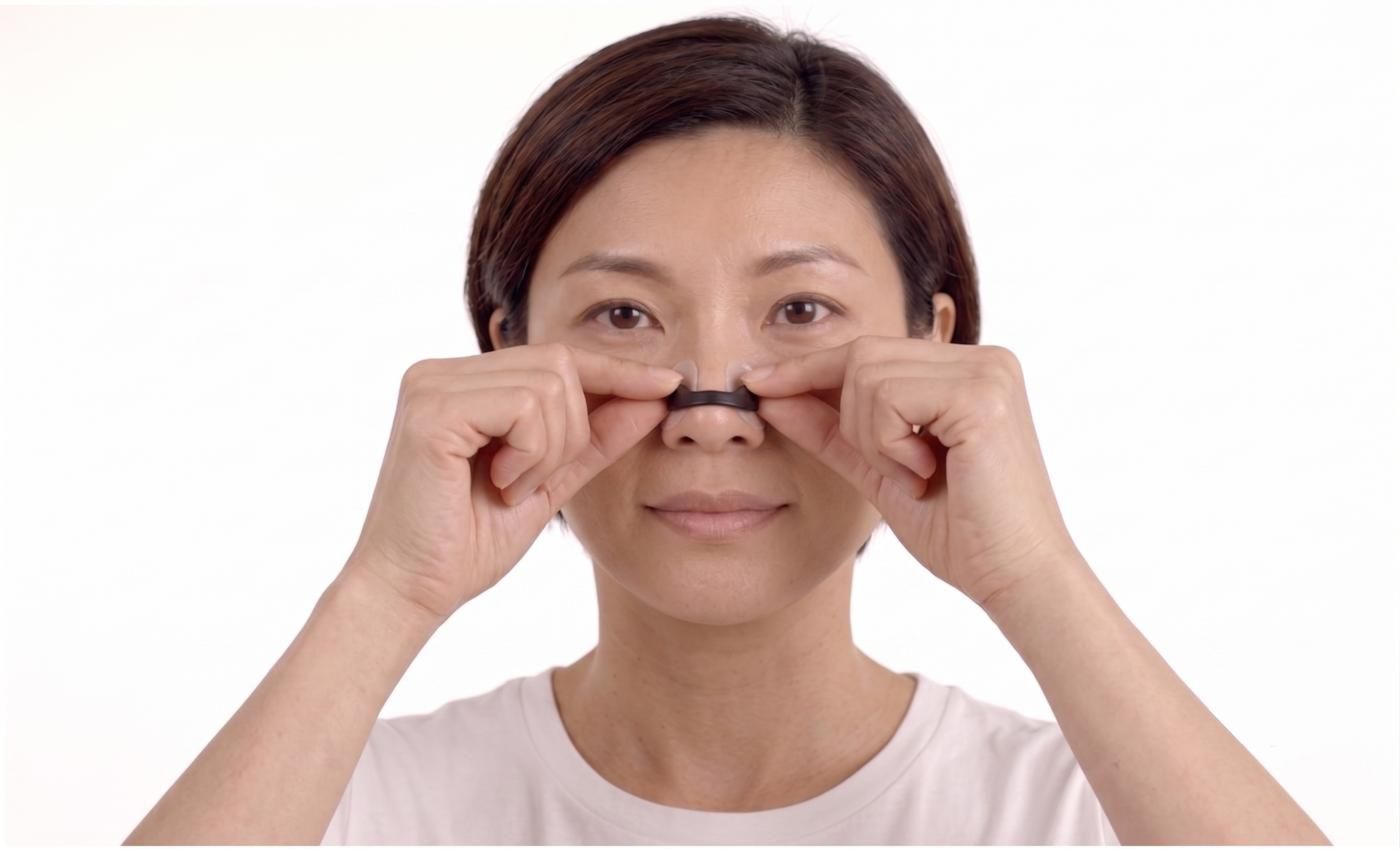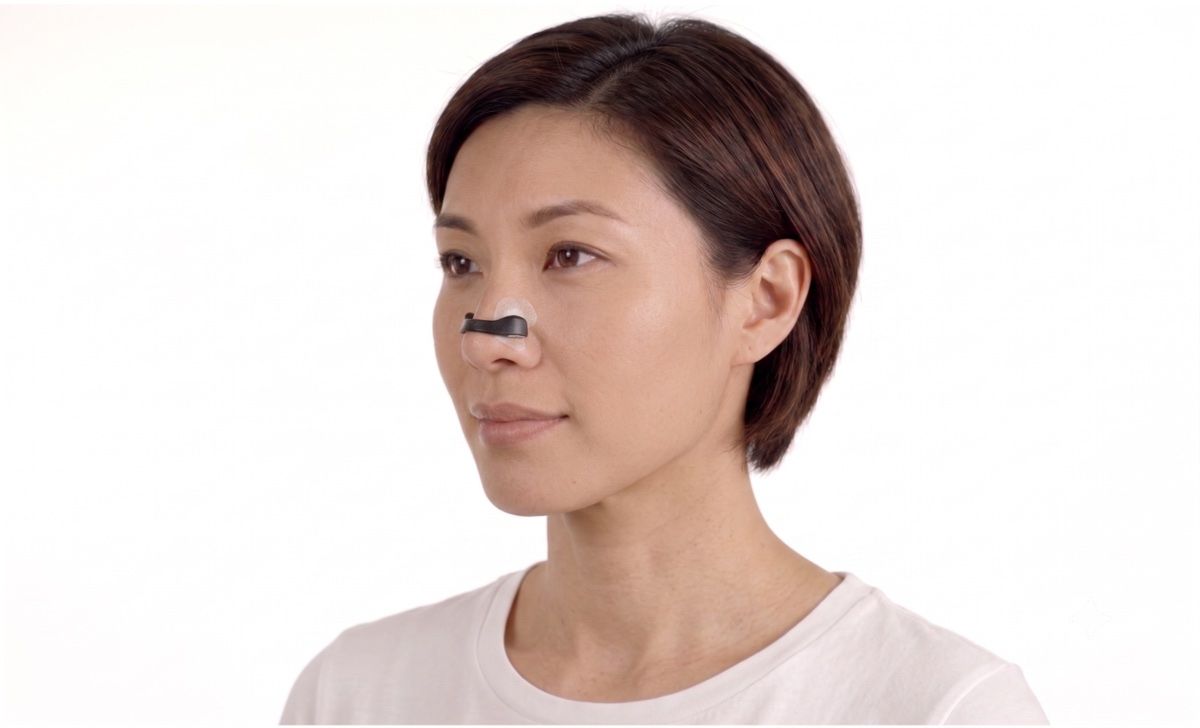
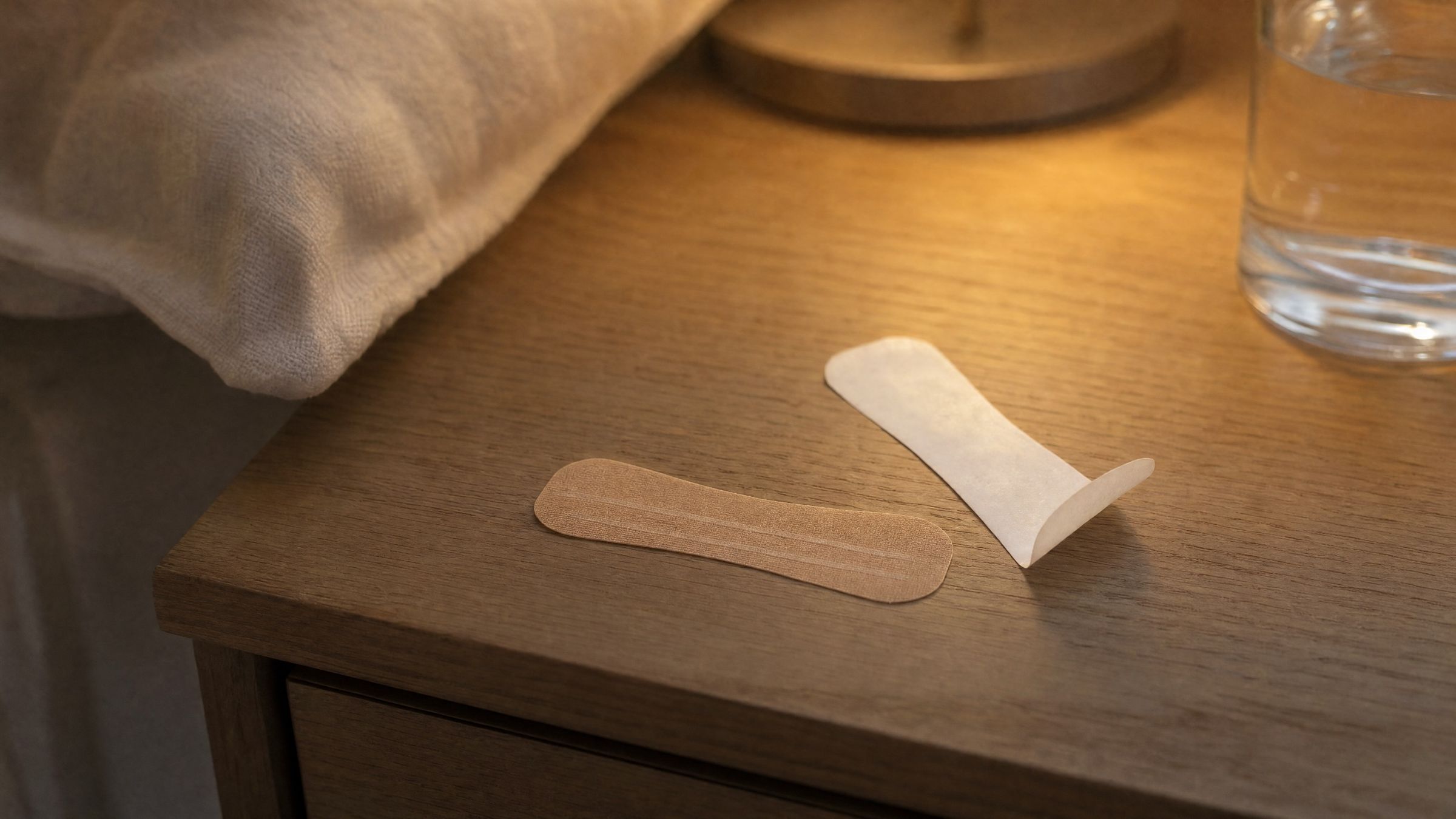
Do nasal strips work? They open the front of the nose, and in studies people said breathing felt easier. But reviews of sleep-lab studies found no significant effect on snoring, and Breathe Right's then-maker found no clear sleep benefit over a dummy strip in its own trials. The side effects trials reported were mostly mild skin reactions.
In short
- Strips lift the sides of the nostrils. In lab tests that raised airflow when breathing in hard, and people said breathing felt easier.
- Reviews of sleep-lab studies found strips made no significant difference to snoring, and trials funded by Breathe Right's then-maker found no clear sleep benefit over a dummy strip.
- There's no study of months of nightly use. The longest strip trial we found ran 28 nights.
- Skin reactions are the side effect trials reported. Stop if a rash appears, and see a GP if snoring comes with pauses in breathing or daytime sleepiness.
Do nasal strips work?
They do one thing reliably: they hold the front of the nose open. The evidence for what most people buy them for, snoring and better sleep, is weak.
A nasal strip is a single-use adhesive band with springy strips inside. It sticks across the nose, just above where the nostrils flare, and as it tries to straighten it lifts the sides of the nostrils outwards.
"Work" can mean several things, and the evidence differs for each. A measured rise in airflow isn't the same as feeling clearer, and neither is the same as quieter snoring or better sleep. Most of the research is on Breathe Right, the best-known brand.
| What studies found | How strong | |
|---|---|---|
| Airflow | Rises when breathing in hard, in lab tests | Small lab studies of healthy, awake adults |
| Feeling clearer | People said breathing felt easier | Fairly consistent, but dummy strips helped too in sleep trials |
| Snoring | No significant change in sleep-lab reviews | Two reviews (2016 and 2026); one small positive trial |
| Sleep | No clear benefit over a dummy strip | Four trials in three papers, funded by GSK, Breathe Right's then-maker |
| Sport | No benefit in the larger review | A review of 19 studies; a smaller review in favour was rated very low certainty |
How do nasal strips work?
The strip stops the sides of the nostrils being sucked inwards when you breathe in.
That was measured in healthy people who were awake and breathing in as hard as they could, not during sleep. Reviews describe external nasal dilators as working by widening the narrowest part of the nose and lowering resistance to airflow, while noting that most studies are small.[2]
Not everyone gets the same lift. A 1999 lab study found an adhesive strip pulled the nostril walls outwards with roughly the same force whatever the width of the nose, and suggested people respond differently partly because their nostril walls differ in how easily they stretch.[3] A 2002 study of Asian adults found the benefit of a nasal strip depended more on the overall shape of a person's nose than on any single measurement.[4] That may be part of why one person notices a real difference with a strip and another notices nothing.
Do nasal strips work for snoring?
Not reliably, going by sleep-lab studies. A 2016 review of 14 studies found nasal dilators didn't improve sleep apnoea, and strips made no significant difference to snoring measured in sleep labs.[5] A 2026 review of 17 studies (496 people) found nasal dilators made no significant difference to snoring or sleep apnoea measured in sleep labs.[6]
Two single trials add detail. In a small trial of 12 people with long-term rhinitis, a nasal strip cut how often they snored compared with a dummy strip, but didn't make the snoring quieter or improve sleep quality.[7] In a GSK-funded 28-night study with no dummy-strip comparison, 70 adults with long-term night-time congestion said they breathed and slept better with a prototype strip, but sleep-lab measures, including snoring, didn't change significantly.[8]
One national sleep society isn't keen either. The Australasian Sleep Association's 2023 position statement on snoring recommends mandibular advancement devices as a first-line option, and doesn't advise over-the-counter remedies such as nasal dilators, because there's no evidence on long-term use.[9]
The NHS snoring page still lists nasal dilators or strips that hold the nose open as one option when snoring is linked to a blocked or narrow nose. So that's when a strip is most worth a try. If you want to compare strips for snoring, our guide to the best nasal strips for snoring goes through them. If you're wondering about mouth tape instead, nasal strips vs mouth tape explains what each one does. And if it's a partner's snoring keeping you up, see how to sleep with a snoring partner.
Do nasal strips help you sleep better?
Not clearly, according to the trials paid for by Breathe Right's then-maker, GSK. People often felt better, but so did people wearing a dummy strip.
In two GSK-funded trials involving 270 adults with night-time congestion, Breathe Right strips didn't improve sleep problems or morning tiredness compared with a dummy strip, though both groups felt better than before the trials began.[10] In a small GSK-sponsored trial of 61 adults with long-term night-time congestion, Breathe Right strips beat a dummy strip on some sleep and breathing ratings but not others, and the dummy strip helped too.[11] And in the 28-night study above, people said they slept better, but there was no dummy strip to compare against and sleep-lab measures mostly didn't change.[8]
| Who took part | What changed | What didn't | |
|---|---|---|---|
| Noss 2019 (GSK-funded) | 270 adults with night-time congestion | Both the real and dummy strip groups felt better than at the start | Sleep problems or morning tiredness compared with a dummy strip |
| Schenkel 2018 (GSK-sponsored) | 61 adults with long-term night-time congestion | Some sleep and breathing ratings beat the dummy strip | Other ratings, including congestion; the dummy strip helped too |
| Wheatley 2019 (GSK-funded) | 70 adults with long-term night-time congestion over 28 nights | People said they breathed and slept better (no dummy strip) | Sleep-lab measures, including snoring |
Sleep researchers have even used nasal strips as the dummy in sleep apnoea trials: in a 2017 trial of 26 people with severe sleep apnoea, strips made no difference to any sleep-lab measure.[12]
Feeling better isn't the same as a measured change, and these trials found both. In a 2001 trial of 18 heavy snorers, strips widened the nose and made it feel clearer, but didn't change how long or how loudly people snored.[13] If a strip makes your nose feel more open, that's worth knowing. It just isn't proof that your sleep or snoring has changed. There's more on how we read the evidence on our science page.
Do nasal strips help a blocked nose?
They hold the outer nostrils open, but they don't clear a cold or an allergy. If the blockage is swelling further inside, a strip can't reach it.
A nose can feel fine by day and worse in bed. A 2022 review of nine studies confirmed that the nose becomes more resistant to airflow when you lie down, and more so in people who snore.[14]

The congestion results are mixed. In a GSK-funded study in Cardiff of 50 healthy adults, three designs of nasal strip each widened the nasal passage and made breathing feel easier compared with wearing no strip.[15] But in the GSK-sponsored trial of 61 congested adults, congestion scores were no better with the real strip than with the dummy one.[11]
A deviated septum is a different problem: it's inside the nose, and a strip works on the outside. Our guide to whether magnetic nasal strips work explains why no external product can move it.
Do nasal strips work for running and sport?
There's no good evidence that they improve performance. A 2022 review of 11 running studies reported results in favour of nasal dilators for VO2max and how hard running felt, but rated the certainty of that evidence as very low.[16] A 2021 review of 19 studies of nasal strips in sport found no benefit.[17]

A 2023 evidence guide by respiratory and exercise scientists concluded that nasal strips may make breathing feel easier, but found no good evidence that they improve exercise performance.[18]
So if you like how one feels on a run, that's a fair reason to wear it. Just don't expect it to make you faster.
Can you use nasal strips every night?
Many people do, but no study we found has followed nightly use for months. The longest strip trial we found ran 28 nights.[8]
A 2026 review by UK surgeons noted that the studies it found didn't follow people up over time, so there's little evidence on longer-term use, and only four of its 13 studies reported on comfort or side effects.[19] The Australasian Sleep Association's statement made the same point about long-term use.[9]
So the best guide is the maker's own instructions. Breathe Right's FAQ says its strips may be used daily but not for more than 12 hours a day, with a fresh strip each time. It says not to use them over sores, sunburned, irritated or broken skin, to stop if a rash or irritation appears, and that children under 5 shouldn't use them.
What are the side effects of nasal strips?
Skin reactions where the strip sits are the side effect trials reported, and they do happen.
In a GSK-funded trial, 82 adults wore Breathe Right strips every night for a week, and an evaluator found no skin irritation in any of them. A week is too short to say anything about months of use.[15] Longer and other trials did find some. In the second of GSK's two 2019 trials, 3 strip users (4.7%) had a reaction where the strip was applied, against 1 person (1.6%) using the dummy strip.[10] In the 28-night study, four people had mild skin reactions where the strip was applied.[8]
Latex is worth checking. Boots' listing for Breathe Right Original says not to use the strips if you're allergic to latex (checked on 27 October 2026).
How you take a strip off matters too. Nursing experts describe skin damage from medical adhesives as common but under-recognised, and say how an adhesive is put on and taken off makes a difference.[20] That work is on hospital adhesives, not nasal strips, but the principle carries over.
If a rash where something touches your skin keeps coming back or is severe, the NHS advises seeing a GP. If strips irritate your skin, our guide to Breathe Right alternatives covers other formats.
If adhesive strips aren't working for you
There are other ways to hold the nose open, and the evidence for each is limited in its own way.
Magnetic clips
The same idea as a strip, but a reusable clip does the lifting and attaches to two small single-use stickers, one on each side of the nose. We could find no published, independent study of any magnetic nasal dilator, including Airlift's. A 2026 review by UK surgeons reached the same conclusion.[19] Our guides to whether magnetic nasal strips work and magnetic vs adhesive nasal strips explain the differences.
Airlift
We make a magnetic clip, so we're not neutral here, and we can't tell you it works better than a strip. Where it differs is the format. If your complaint is the strip itself, the wrong size, a band across the bridge, or throwing one away every night, Airlift is built around those:
- All five clip sizes, XS to XL, come in every box.
- Nothing goes inside your nose, and there's no strip across the bridge.
- The stickers use a latex-free adhesive.
- Prep pads come with every 30 nights, to clean skin oil off before the stickers go on.
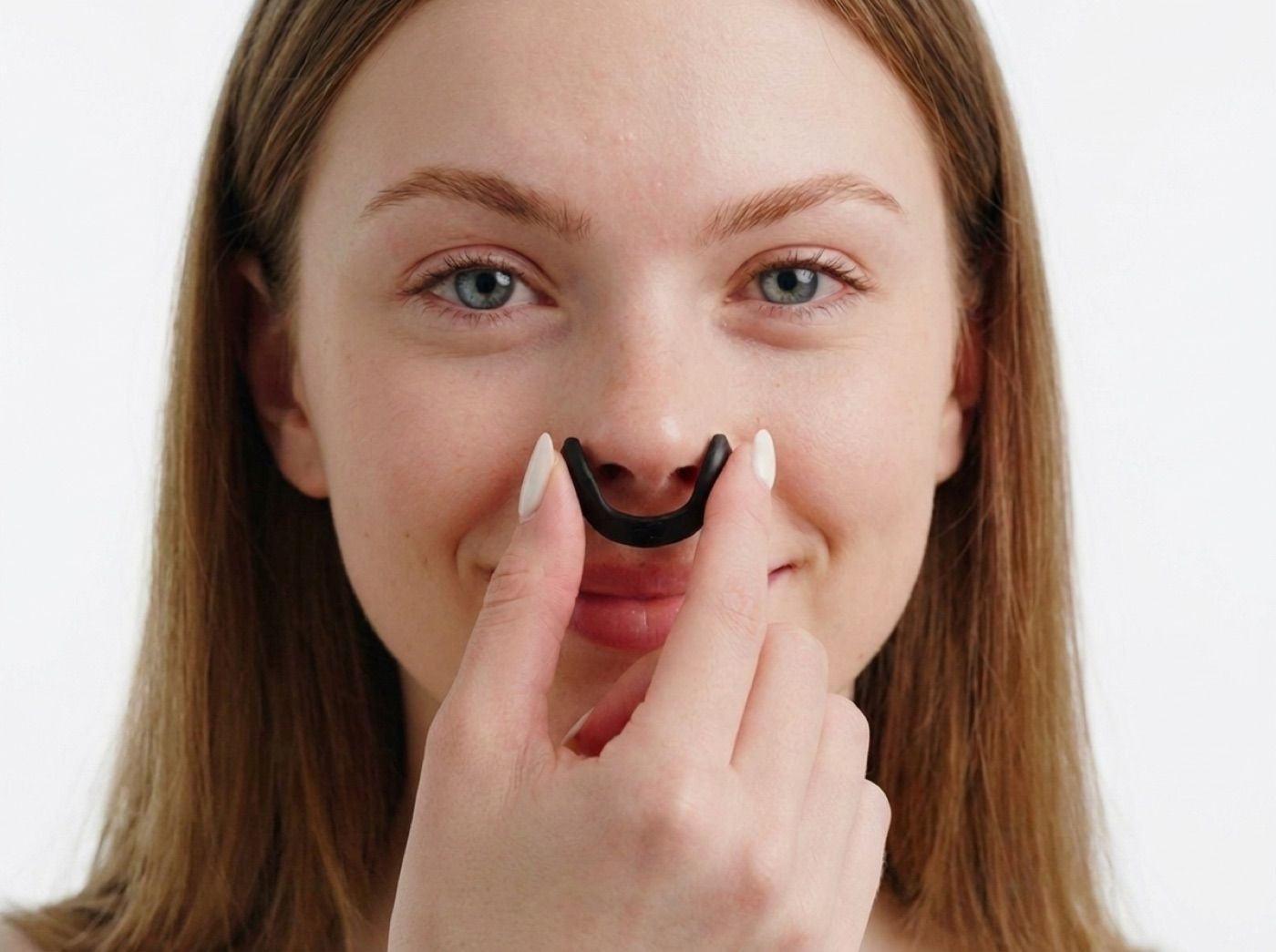
There's no published, independent study of any magnetic dilator to go on, so the sensible way to try is one where you can get your money back without sending anything back. Under the 90-Night Airlift Test, you can email within 90 days of receiving your order for a full refund, including delivery. You keep the clip and send nothing back. It's once per customer.
The Complete starter (£33) has the clip in every size, 30 nights of stickers and 30 prep pads. The Complete Annual plan works out at 67p a night including the clip, and every subscription order ships free by next-day delivery, with no minimum spend.
Internal dilators
These sit just inside the nostrils, with no adhesive. A 2026 review by UK surgeons found most research is on adhesive strips such as Breathe Right, and that devices worn inside the nostril tended to perform better than external ones.[19] Our comparison of an internal dilator and a magnetic clip goes into the trade-offs.
When to see a GP
The NHS says to see a GP if snoring is having a big impact on you or your partner, or if you're sleepy in the day, your breathing stops and starts, or you gasp or choke in your sleep.
A strip isn't the answer to sleep apnoea. A 2016 review of 14 studies found nasal dilators didn't improve sleep apnoea.[5] If you've been given a CPAP machine, keep using it exactly as prescribed.
Questions people ask
References
- Di Somma EM, West SN, Wheatley JR, Amis TC (1999). Nasal dilator strips increase maximum inspiratory flow via nasal wall stabilization. Laryngoscope, 109(5), 780-784. doi.org/10.1097/00005537-199905000-00018
- Dinardi RR, de Andrade CR, Ibiapina CdC (2014). External nasal dilators: definition, background, and current uses. International Journal of General Medicine, 7, 491-504. doi.org/10.2147/IJGM.S67543
- Amis TC, Kirkness JP, di Somma E, Wheatley JR (1999). Nasal vestibule wall elasticity: interactions with a nasal dilator strip. Journal of Applied Physiology, 86(5), 1638-1643. doi.org/10.1152/jappl.1999.86.5.1638
- Ochi K, Ohashi T (2002). The effects of an external nasal dilator and nasal dimensions in Asians. Otolaryngology-Head and Neck Surgery, 126(2), 160-163. doi.org/10.1067/mhn.2002.122262
- Camacho M, Malu OO, Kram YA, Nigam G, Riaz M, Song SA, Tolisano AM, Kushida CA (2016). Nasal dilators (Breathe Right strips and NoZovent) for snoring and OSA: a systematic review and meta-analysis. Pulmonary Medicine, 2016, 4841310. doi.org/10.1155/2016/4841310
- Alotaibi S, Bin Saddiq BW, Alfarhoud RS, Alghamdi MTN, Alsaffar AJ, Alnabhan AM, Alkhateeb MA, Albahrani KH, Alowibidy SA, Almahdi ZI, Almaghrabi HA, Alnabulsi M (2026). Clinical effectiveness of nasal dilators in sleep-disordered breathing: a systematic review and meta-analysis. Cureus, 18(1), e100663. doi.org/10.7759/cureus.100663
- Pevernagie D, Hamans E, Van Cauwenberge P, Pauwels R (2000). External nasal dilation reduces snoring in chronic rhinitis patients: a randomized controlled trial. European Respiratory Journal, 15(6), 996-1000. doi.org/10.1034/j.1399-3003.2000.01504.x
- Wheatley JR, Amis TC, Lee SA, Ciesla R, Shanga G (2019). Objective and subjective effects of a prototype nasal dilator strip on sleep in subjects with chronic nocturnal nasal congestion. Advances in Therapy, 36(7), 1657-1671. doi.org/10.1007/s12325-019-00980-z
- Sarkis LM, Jones AC, Ng A, Pantin C, Appleton SL, MacKay SG (2023). Australasian Sleep Association position statement on consensus and evidence based treatment for primary snoring. Respirology, 28(2), 110-119. doi.org/10.1111/resp.14443
- Noss MJ, Ciesla R, Shanga G (2019). Sleep quality and congestion with Breathe Right nasal strips: two randomized controlled trials. Advances in Therapy, 36(8), 1975-1985. doi.org/10.1007/s12325-019-01005-5
- Schenkel EJ, Ciesla R, Shanga GM (2018). Effects of nasal dilator strips on subjective measures of sleep in subjects with chronic nocturnal nasal congestion: a randomized, placebo-controlled trial. Allergy, Asthma & Clinical Immunology, 14, 34. doi.org/10.1186/s13223-018-0258-5
- Yagihara F, Lorenzi-Filho G, Santos-Silva R (2017). Nasal dilator strip is an effective placebo intervention for severe obstructive sleep apnea. Journal of Clinical Sleep Medicine, 13(2), 215-221. doi.org/10.5664/jcsm.6450
- Djupesland PG, Skatvedt O, Borgersen AK (2001). Dichotomous physiological effects of nocturnal external nasal dilation in heavy snorers: the answer to a rhinologic controversy?. American Journal of Rhinology, 15(2), 95-103. doi.org/10.2500/105065801781543745
- Calvo-Henríquez C, Chiesa-Estomba C, Lechien JR, Carrasco-Llatas M, Cammaroto G, Mayo-Yáñez M, Abelleira-Paris R, Gonzalez-Barcala FJ, Martinez-Capoccioni G, Martin-Martin C (2022). The recumbent position affects nasal resistance: a systematic review and meta-analysis. Laryngoscope, 132(1), 6-16. doi.org/10.1002/lary.29509
- Ward J, Ciesla R, Becker W, Marava Shanga G (2018). Randomized trials of nasal patency and dermal tolerability with external nasal dilators in healthy volunteers. Allergy & Rhinology, 9, 2152656718796740. doi.org/10.1177/2152656718796740
- Gomes SKSP, Malaguti C, Elias Filho J, Caetano RO, da Silva CV, de Oliveira TMD, Hespanhol L, Felício DC (2022). Nasal dilator and physiological parameters associated to running performance: a systematic review and meta-analysis. Journal of Sports Sciences, 40(20), 2315-2326. doi.org/10.1080/02640414.2022.2151752
- Dinardi RR, Ferreira CHS, Silveira GS, de Araújo Silva VE, da Cunha Ibiapina C, de Andrade CR (2021). Does the external nasal dilator strip help in sports activity? A systematic review and meta-analysis. European Archives of Oto-Rhino-Laryngology, 278(5), 1307-1320. doi.org/10.1007/s00405-020-06202-5
- Illidi CR, Romer LM, Johnson MA, Williams NC, Rossiter HB, Casaburi R, Tiller NB (2023). Distinguishing science from pseudoscience in commercial respiratory interventions: an evidence-based guide for health and exercise professionals. European Journal of Applied Physiology, 123(8), 1599-1625. doi.org/10.1007/s00421-023-05166-8
- Ahmed A, Gakpetor C, Yang D, Oremule B, Ranganathan B, Jaiswal A, Bhalla RK (2026). The effectiveness of nonsurgical nasal devices in relieving nasal obstruction. Annals of the Royal College of Surgeons of England, 108(6), 476-483. doi.org/10.1308/rcsann.2025.0103
- McNichol L, Lund C, Rosen T, Gray M (2013). Medical adhesives and patient safety: state of the science. Consensus statements for the assessment, prevention, and treatment of adhesive-related skin injuries. Journal of Wound, Ostomy and Continence Nursing, 40(4), 365-380. doi.org/10.1097/WON.0b013e3182995516

Written by Nicholas Green
I've found it hard to breathe through my nose for as long as I can remember, and years of products and even surgery didn't fix it, so I built Airlift. I write about what I've learned along the way, as someone who lives with it rather than as a clinician.
How we research and check articles: our editorial standards.