Nasal strips vs mouth tape: they do different jobs, and the nose comes first. For most UK buyers who want nothing inside the nose and no strip across the bridge, Airlift's magnetic clip is the pick, with 90 nights to try it, nothing sent back. Tape only keeps your lips closed, so never use it over a blocked nose.
In short
- For most UK buyers, start with the nose. Airlift's magnetic clip holds the nostrils open with nothing inside the nose and all five sizes in the box, and you can claim a full refund within 90 days of receiving your order with nothing to send back. A Breathe Right strip (£0.47 a night at Boots) is the cheaper way to try. Tape only keeps the lips closed, so it can't stand in for either.
- Your nose comes first, so never tape over a blocked nose. A 2025 review warned that taping could be dangerous for people whose nose is blocked.
- The evidence for either one on snoring is thin, and the only trial we found that used both together bundled them with other measures.
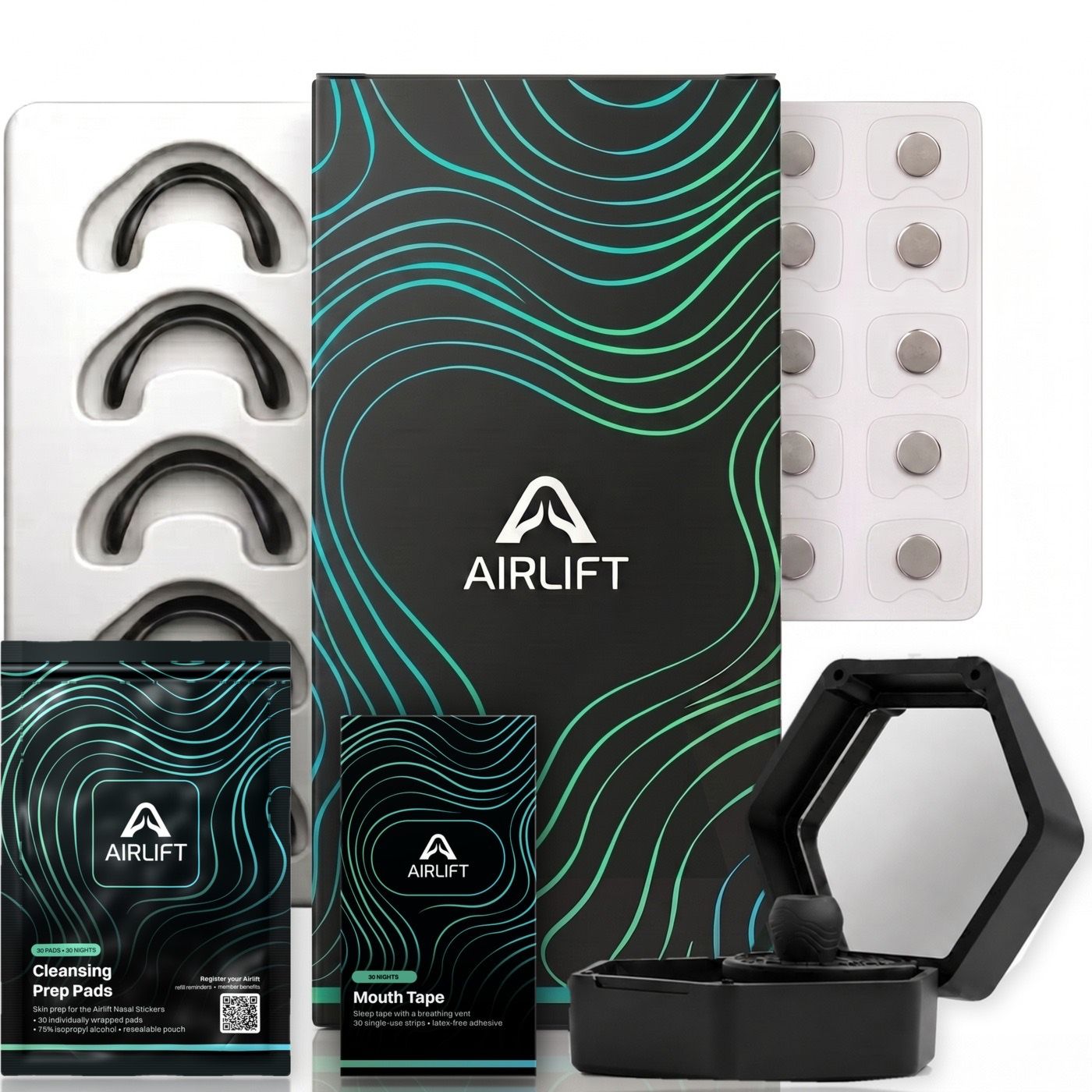
- If you want to try both, Airlift's Ultimate has a reusable magnetic clip in all five sizes, nasal stickers, prep pads and mouth tape in one box, covered by the 90-Night Airlift Test.
Nasal strips vs mouth tape: what's the difference?
A nasal strip opens the front of your nose, and mouth tape keeps your lips closed. They aren't doing the same thing, so one can't stand in for the other.
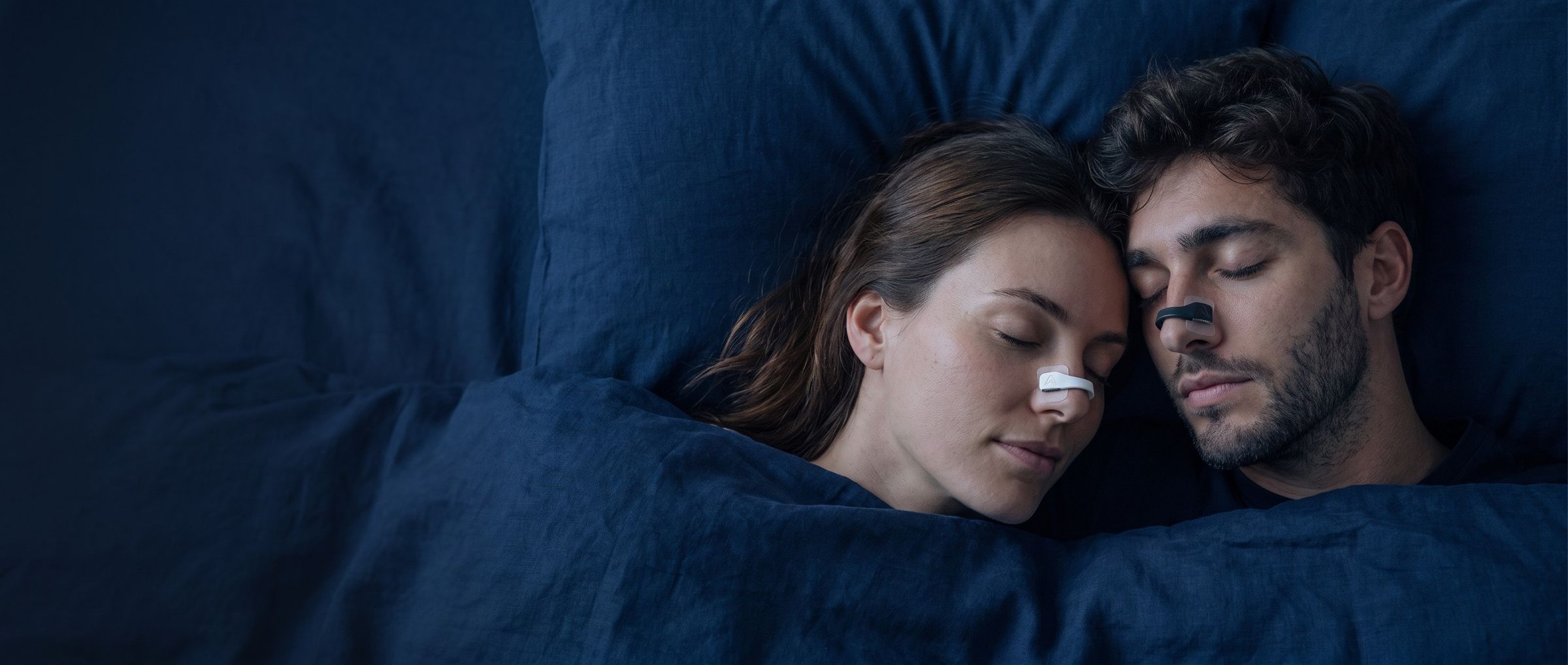
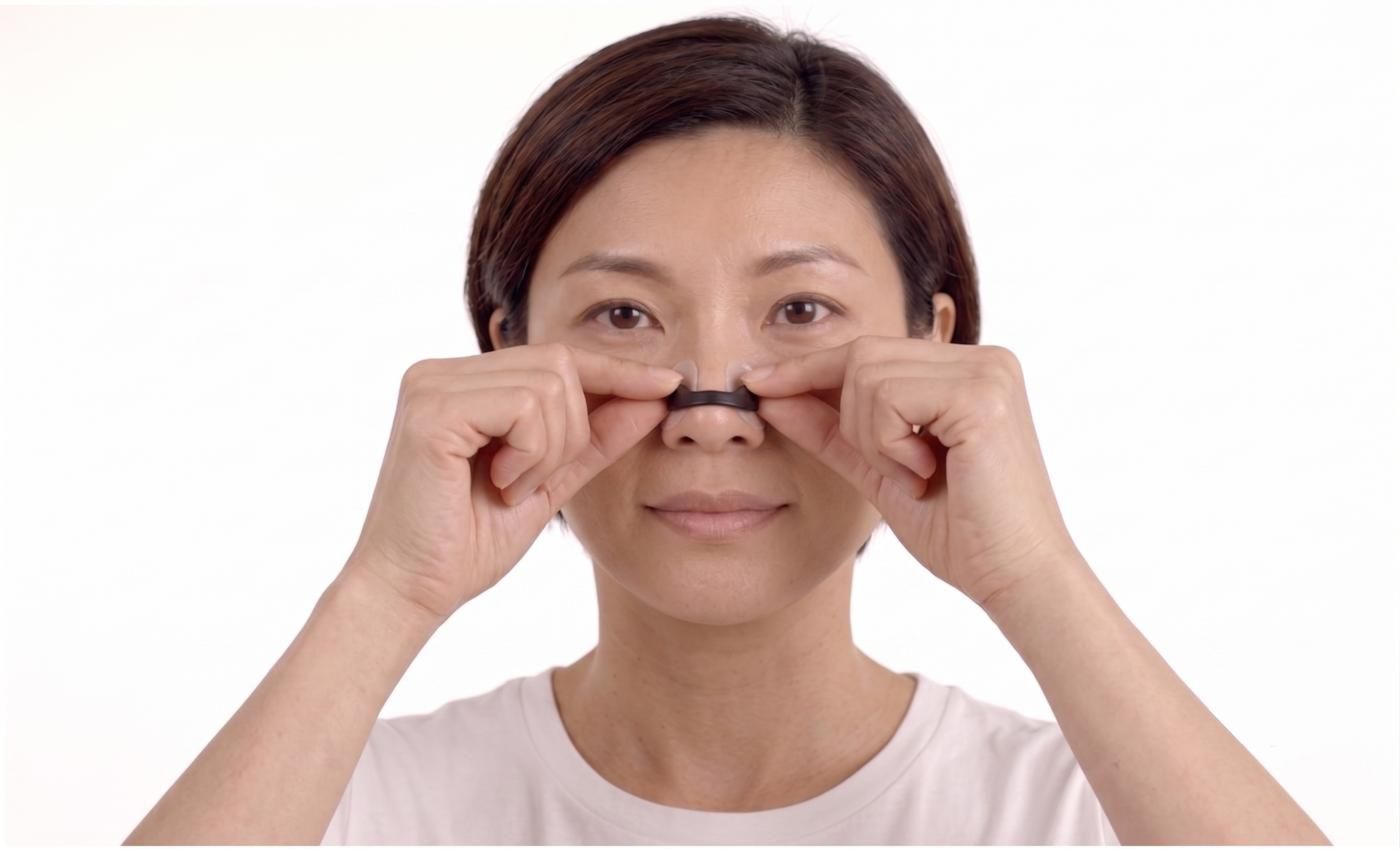
A nasal strip is a springy band stuck across the nose that lifts the sides of the nostrils. A magnetic nasal strip does the same job with a reusable clip that joins two small stickers, one on the outside of each nostril. The magnet is only a connector; the lift is mechanical. Our guide to whether magnetic nasal strips work explains how they're put together.
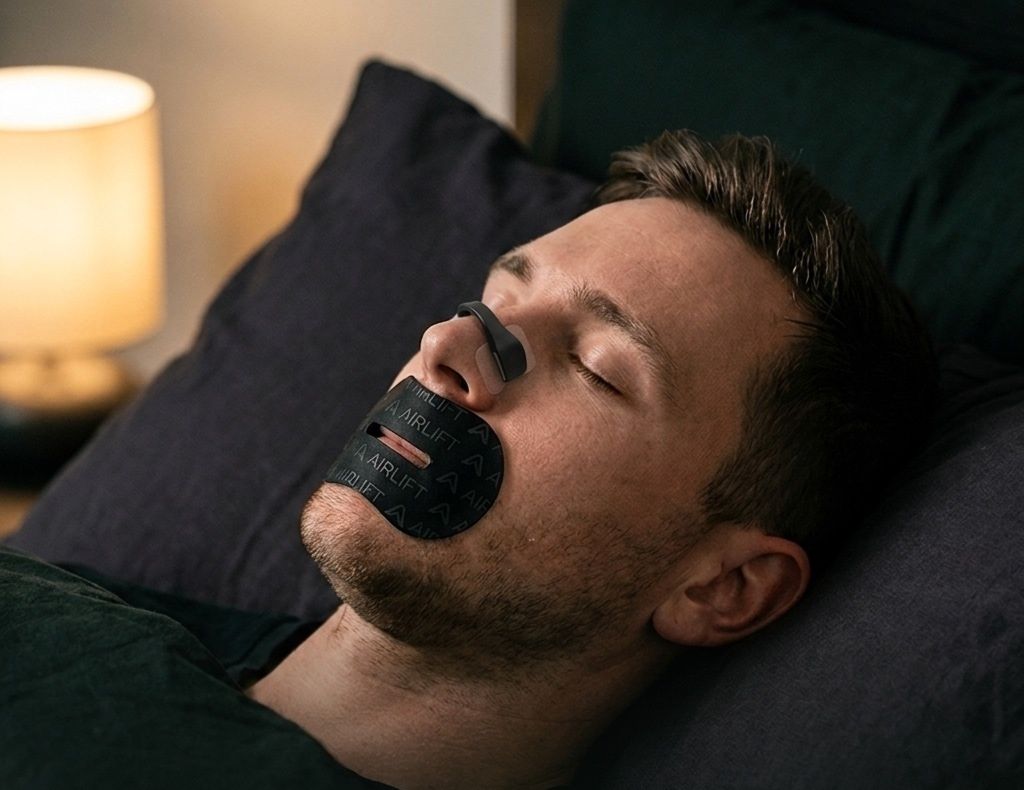
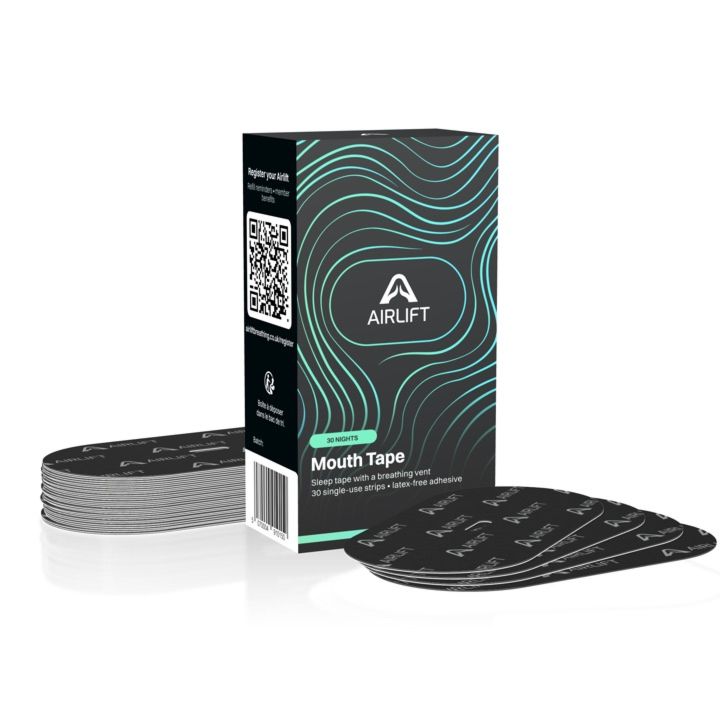
Mouth tape is a small adhesive strip worn over the lips while you sleep. All it does is stop your mouth falling open, so it does nothing for a blocked nose and can be risky over one. If you want to know why the mouth falls open at night in the first place, start with why you mouth breathe at night.
| Adhesive nasal strip | Magnetic clip | Mouth tape | |
|---|---|---|---|
| What it does | Lifts the sides of the nostrils | Holds the nostrils open from the sides | Keeps the lips closed |
| Where it sticks | Across the nose, above the nostrils | Two small stickers, one outside each nostril | Over the lips |
| Reusable part | None | The clip | None |
| On a blocked nose | Opens the front of the nose, but won't clear congestion | Opens the front of the nose, but won't clear congestion | Don't use it |
| Used up each night | One strip | One pair of stickers | One piece of tape |
| UK cost per night (one-time) | £0.47 (Breathe Right at Boots) | £1.10 (Airlift Complete starter); £0.51 for stickers once you own the clip | £0.67 (Airlift mouth tape, 30 for £20) |
Which should you try first?
Start with your nose. If air can't get through it easily, closing your mouth just takes away your other way of breathing.
A nose that feels fine during the day can feel worse in bed. A 2022 review of nine studies confirmed that the nose becomes more resistant to airflow when you lie down, and more so in people who snore.[1]
The NHS snoring page splits the options the same way. It lists nasal dilators or strips that hold the nose open as one option when snoring is linked to a blocked or narrow nose. For a mouth that falls open, it lists a chin strap or a vestibular shield, a device worn in the mouth. Mouth tape isn't on its list.

If your nose is clear and you'd like to try opening it before adding tape, the pick for most people who want nothing inside the nose and no strip across the bridge is Airlift's magnetic clip. The Complete starter (£33) has the clip in all five sizes, with stickers and prep pads. A Breathe Right strip is the cheaper way to try the idea first. Neither the clip nor the strip clears a blocked nose; both just hold the nostrils open while you wear them.
Do nasal strips or mouth tape help snoring?
Neither has good evidence behind it for snoring. The research on both is small, and much of it points the other way.
Mouth tape
A 2025 review of 10 small studies found little good evidence that mouth taping helps, and warned it could be dangerous for people whose nose is blocked.[2] Another 2025 review found only nine studies of mouth taping, with mixed results, and most of the claims made for it on TikTok had never been tested.[3]
The one encouraging result is narrow. In a small 2022 study without a control group, 20 mouth breathers with mild sleep apnoea snored less on a night with their mouth taped.[4] With no comparison night and only 20 people, it can't tell you what tape would do for you.
Nasal strips
These are studies of nasal strips and other dilators, not magnetic clips. A 2016 review of 14 studies found nasal dilators didn't improve sleep apnoea, and strips made no significant difference to snoring measured in sleep labs.[5] A 2026 review of 17 studies (496 people) found nasal dilators made no significant difference to snoring or sleep apnoea measured in sleep labs.[6] Do nasal strips work? has the rest of the strip research.
One small trial was more positive. In a small trial of 12 people with long-term rhinitis, a nasal strip cut how often they snored compared with a dummy strip, but didn't make the snoring quieter or improve sleep quality.[7] Trials paid for by the strip's then-maker found no sleep benefit over a dummy strip. In two GSK-funded trials involving 270 adults with night-time congestion, Breathe Right strips didn't improve sleep problems or morning tiredness compared with a dummy strip, though both groups felt better than before the trials began.[8]
We could find no published, independent study of any magnetic nasal dilator, including Airlift's. A 2026 review by UK surgeons reached the same conclusion.[9] Strip results can't be borrowed for magnetic clips. If you want to compare strips for snoring, our guide to the best nasal strips for snoring goes through the options, and our science page has more on how dilators work.
Is snoring a mouth problem?
Not as simply as many tape sellers say.
Snoring isn't always a mouth-breathing problem: in one clinic series of 25 people with swollen nasal tissue, 17 snored while breathing through the nose and less or not at all through the mouth.[11]
There is some physiology on the mouth side. In small sleep-lab studies of healthy adults, breathing through an open mouth during sleep made the throat more prone to narrowing and collapse than breathing through the nose.[12][13] But the link isn't simple: one sleep study of 41 adults found no connection between mouth breathing and snoring, and some people snore only when breathing through the nose.[14][11]
The nose side has a clearer link. People who said they were congested at night always or almost always were about three times as likely to snore most nights as people who never were, in a US study of working adults.[15] That doesn't show that opening the nose changes snoring, and nothing here shows that tape or nasal breathing makes snoring go away. If you're here because of a partner's snoring, how to sleep with a snoring partner starts with what to try tonight.

Is mouth taping safe?
Not if your nose is blocked. A 2025 review of 10 small studies warned that taping could be dangerous for people whose nose is blocked, and noted that many of the studies had excluded them.[2]
Two other findings explain why. A 2026 review found that when the nose is blocked, for example by packing after surgery, breathing interruptions during sleep increase.[16] And a 2024 study found that closing the mouth improved airflow for some people with sleep apnoea but made it worse for those who relied most on mouth breathing.[17]
Our own guidance, from our article on mouth breathing, is short. Only use mouth tape if you can breathe comfortably through your nose. Don't use it if you have a cold, a blocked nose, or have been told you have a sleep or breathing condition.
Some mouth tapes, Airlift's included, have a small vent or gap in the middle. A vent doesn't make it OK to tape over a blocked nose. If your nose isn't clear that night, leave the tape off.
And nasal strips?
Strips and clips sit on the outside of the nose and don't close any airway, so the risks are mostly about skin and, for clips, magnets.
Breathe Right's FAQ says not to use its strips over sores, sunburned, irritated or broken skin, to stop if a rash or irritation appears, not to wear them for more than 12 hours a day, and that children under 5 shouldn't use them.
For Airlift's clip, the warnings are about the magnets. Keep the clip at least 15cm from pacemakers and other implanted medical devices, take it off before an MRI scan, and keep the clip and applicator away from children under 14 and from pets. Don't put the stickers on broken skin.
Can you use nasal strips and mouth tape together?
Yes, if your nose is clear. Open the nose first, check you can breathe through it comfortably with your lips closed, and only then add tape.
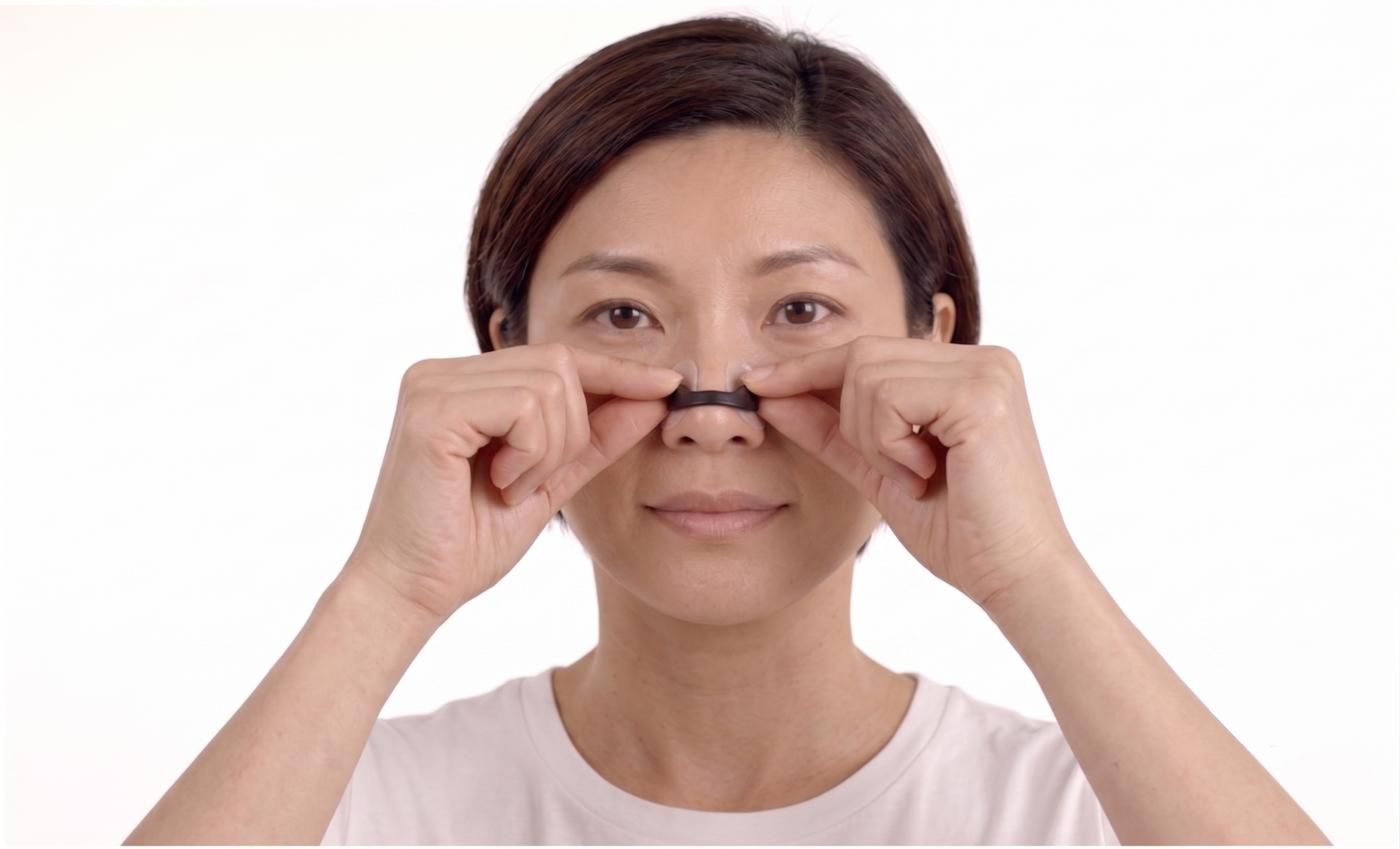
There's almost no research on the two together. The only trial we found that used both bundled them with other measures. In a 2024 US pilot trial of 50 couples, partners rated snoring much improved for 91% of people given a custom mandibular advancement device, against 58% of those given a routine of nasal strips, a steroid nasal rinse, mouth tape and side-sleeping.[18] The four parts of that routine were given together, so none of them can be credited or blamed on its own.
If you want to try both, do it in this order:
- Clean the skin on the sides of your noseWipe it with a prep pad so the skin is clean and dry. Stickers and strips hold best on skin without oil or moisturiser.
- Fit the strip or clipPut the strip across your nose, or press the two stickers onto the outside of each nostril and attach the clip.
- Check your nose firstClose your lips and breathe through your nose for a minute or two. If it feels like hard work, stop here and skip the tape tonight.
- Then put the tape onPress it over your closed lips on clean, dry skin.
With Airlift, the stickers sit on the outside of each nostril and the tape sits on the lips, so the two adhesives don't overlap.
What do strips, clips and tape cost in the UK?
An adhesive strip on its own is the cheapest way to try opening your nose. Prices below were checked on 27 October 2026, for both Airlift and Breathe Right (at Boots' standard price).
| One-time | Per night | Ongoing | |
|---|---|---|---|
| Breathe Right Original Small/Medium, 30 strips (Boots) | £13.99 | £0.47 | Buy packs as you need them |
| Airlift mouth tape, 30 nights | £20 | £0.67, or £0.83 with £5 delivery on an order under £50 | Same price per pack |
| Airlift Complete starter: clip in 5 sizes, stickers, prep pads | £33 | £1.10, or £1.27 with £5 delivery | Annual plan £240: £0.67. Stickers only, 360 nights, once you own a clip: £0.51 |
| Airlift Ultimate starter: Complete plus mouth tape | £46 | £1.53, or £1.70 with £5 delivery | Annual plan £336: £0.93 |
On the Annual plans, the tape adds about 27p a night (£0.93 a night for Ultimate against £0.67 for Complete). Every subscription order ships free by next-day delivery, with no minimum spend. You can also buy Airlift mouth tape on its own (£20 for 30) to go with a strip or clip you already have.
To try both from one box, there's the Ultimate starter (£46), or the Ultimate Annual plan if you'd rather go straight to a plan. Our guide to magnetic vs adhesive nasal strips compares the two nose formats in more detail, and if you've tried Breathe Right and want something different, see our Breathe Right alternatives.
Where Airlift fits
We sell both, so we have a reason to want you to buy both. Many people only need the nose half, though.
Complete is the clip on its own, with stickers and prep pads. Ultimate adds mouth tape. Tape is optional, and plenty of people wear the clip on its own and never tape at all. If you only want to open your nose, the Complete starter (£33) is where to start.
What you get either way:
- All five clip sizes, XS to XL, in every box, so you don't have to guess your size.
- Prep pads in every delivery, 30 per 30 nights, to clean skin oil off before the stickers go on.
- Nothing inside your nose and no strip across the bridge. The clip sits on two small stickers.
- The 90-Night Airlift Test. If it isn't right for you, email within 90 days of receiving your order for a full refund, including delivery. You keep the clip and send nothing back. It's once per customer.
With so little research on either product, the sensible way to try is one where you can get your money back without sending anything back.
Questions people ask
References
- Calvo-Henríquez C, Chiesa-Estomba C, Lechien JR, Carrasco-Llatas M, Cammaroto G, Mayo-Yáñez M, Abelleira-Paris R, Gonzalez-Barcala FJ, Martinez-Capoccioni G, Martin-Martin C (2022). The recumbent position affects nasal resistance: a systematic review and meta-analysis. Laryngoscope, 132(1), 6-16. doi.org/10.1002/lary.29509
- Rhee J, Iansavitchene A, Mannala S, Graham ME, Rotenberg B (2025). Breaking social media fads and uncovering the safety and efficacy of mouth taping in patients with mouth breathing, sleep disordered breathing, or obstructive sleep apnea: a systematic review. PLoS One, 20(5), e0323643. doi.org/10.1371/journal.pone.0323643
- Fangmeyer SK, Badger CD, Thakkar PG (2025). Nocturnal mouth-taping and social media: a scoping review of the evidence. American Journal of Otolaryngology, 46(1), 104545. doi.org/10.1016/j.amjoto.2024.104545
- Lee YC, Lu CT, Cheng WN, Li HY (2022). The impact of mouth-taping in mouth-breathers with mild obstructive sleep apnea: a preliminary study. Healthcare (Basel), 10(9), 1755. doi.org/10.3390/healthcare10091755
- Camacho M, Malu OO, Kram YA, Nigam G, Riaz M, Song SA, Tolisano AM, Kushida CA (2016). Nasal dilators (Breathe Right strips and NoZovent) for snoring and OSA: a systematic review and meta-analysis. Pulmonary Medicine, 2016, 4841310. doi.org/10.1155/2016/4841310
- Alotaibi S, Bin Saddiq BW, Alfarhoud RS, Alghamdi MTN, Alsaffar AJ, Alnabhan AM, Alkhateeb MA, Albahrani KH, Alowibidy SA, Almahdi ZI, Almaghrabi HA, Alnabulsi M (2026). Clinical effectiveness of nasal dilators in sleep-disordered breathing: a systematic review and meta-analysis. Cureus, 18(1), e100663. doi.org/10.7759/cureus.100663
- Pevernagie D, Hamans E, Van Cauwenberge P, Pauwels R (2000). External nasal dilation reduces snoring in chronic rhinitis patients: a randomized controlled trial. European Respiratory Journal, 15(6), 996-1000. doi.org/10.1034/j.1399-3003.2000.01504.x
- Noss MJ, Ciesla R, Shanga G (2019). Sleep quality and congestion with Breathe Right nasal strips: two randomized controlled trials. Advances in Therapy, 36(8), 1975-1985. doi.org/10.1007/s12325-019-01005-5
- Ahmed A, Gakpetor C, Yang D, Oremule B, Ranganathan B, Jaiswal A, Bhalla RK (2026). The effectiveness of nonsurgical nasal devices in relieving nasal obstruction. Annals of the Royal College of Surgeons of England, 108(6), 476-483. doi.org/10.1308/rcsann.2025.0103
- Bushell MK, Baldock PJ, Antic R, Thornton AT, McEvoy RD (1991). Obligatory nasal breathing: effects on snoring and sleep apnoea. Medical Journal of Australia, 155(2), 83-85. doi.org/10.5694/j.1326-5377.1991.tb142131.x
- Hsia JC, Camacho M, Capasso R (2014). Snoring exclusively during nasal breathing: a newly described respiratory pattern during sleep. Sleep and Breathing, 18(1), 159-164. doi.org/10.1007/s11325-013-0864-x
- Fitzpatrick MF, McLean H, Urton AM, Tan A, O'Donnell D, Driver HS (2003). Effect of nasal or oral breathing route on upper airway resistance during sleep. European Respiratory Journal, 22(5), 827-832. doi.org/10.1183/09031936.03.00047903
- Meurice JC, Marc I, Carrier G, Sériès F (1996). Effects of mouth opening on upper airway collapsibility in normal sleeping subjects. American Journal of Respiratory and Critical Care Medicine, 153(1), 255-259. doi.org/10.1164/ajrccm.153.1.8542125
- Madronio MR, Di Somma E, Stavrinou R, Kirkness JP, Goldfinch E, Wheatley JR, Amis TC (2004). Older individuals have increased oro-nasal breathing during sleep. European Respiratory Journal, 24(1), 71-77. doi.org/10.1183/09031936.04.00004303
- Young T, Finn L, Palta M (2001). Chronic nasal congestion at night is a risk factor for snoring in a population-based cohort study. Archives of Internal Medicine, 161(12), 1514-1519. doi.org/10.1001/archinte.161.12.1514
- Alshehri NA, Alsaif NF, Abdulrazaq AN, Jabor RM, Al-Sayed AA (2026). Impact of nasal obstruction and mouth taping on sleep apnea indicators: systematic review and meta-analysis. OTO Open, 10(3), e70294. doi.org/10.1002/oto2.70294
- Yang H, Huyett P, Wang TY, et al. (2024). Mouth closure and airflow in patients with obstructive sleep apnea: a nonrandomized clinical trial. JAMA Otolaryngology-Head & Neck Surgery, 150(11), 1012-1019. doi.org/10.1001/jamaoto.2024.3319
- Ioerger P, Afshari A, Hentati F, Strober W, Kallogjeri D, Ju YE, Piccirillo JF (2024). Mandibular advancement vs combined airway and positional therapy for snoring: a randomized clinical trial. JAMA Otolaryngology-Head & Neck Surgery, 150(7), 572-579. doi.org/10.1001/jamaoto.2024.1035

Written by Nicholas Green
I've found it hard to breathe through my nose for as long as I can remember, and years of products and even surgery didn't fix it, so I built Airlift. I write about what I've learned along the way, as someone who lives with it rather than as a clinician.
How we research and check articles: our editorial standards.