
Why is my nose blocked at night? Lying down makes the nose more resistant to airflow, and lying on your side tends to block the lower nostril while the upper one opens. Many noses also take turns, one side then the other. Allergies, a cold, swollen tissue, a bent septum or a narrow nostril can add to it.
In short
- Lying down makes your nose more resistant to airflow, and lying on your side tends to block the lower nostril.
- Many noses take turns. One side swells while the other opens, and turning over in bed can switch which side is clear.
- If it's blocked every night, allergies, long-lasting sinus problems, a bent septum or a narrow nostril are common reasons, and some are worth getting checked.
Why is my nose blocked at night?
Mostly because you're lying down. Your nose works differently when you're flat in bed than when you're upright, and for many people that's enough to make it feel blocked by bedtime, even if it was clear all day. This page is about adults.
The term to know is nasal resistance: how hard it is to move air through your nose. The higher it is, the more blocked your nose feels. A 2022 review of nine studies confirmed that the nose becomes more resistant to airflow when you lie down, and more so in people who snore.[1] In a 1998 study, lying down raised nasal resistance by more in 70 snorers than in 11 non-snorers, though another study found no such difference.[2]
That helps explain why a nose can feel clear all day and blocked at night: the change comes with lying down, whatever the hour.

That's about one in six. We found no verified UK figure, so the closest guide is this US study.
Why is only one side of my nose blocked?
Usually because of the nasal cycle, or the side you sleep on, or both.
That study measured people during the day. Later work recorded the cycle around the clock: during sleep, the nasal cycle slows down, with each side staying more open or more closed for longer, and turning over in bed can switch which side is clear.[5][6]
The side you lie on matters too. In small studies, lying on your side tended to block the lower nostril and open the upper one, and in people with allergic rhinitis these changes with posture were bigger.[7][8]

Is a blocked nose at night linked to snoring?
Yes, the two tend to go together, though that's a link and not proof that one causes the other. People who said they were congested at night always or almost always were about three times as likely to snore most nights as people who never were.[3] A 10-year study of 10,112 adults in five Nordic and Baltic countries found people who reported nose symptoms at the start were more likely to be snoring 10 years later.[9]
Neither study shows that opening the nose changes snoring. If you snore and your nose is often blocked, our guide on whether your snoring is coming from your nose goes through the signs.
A blocked nose can also leave you breathing through your mouth. Our guide to why you mouth breathe at night covers that side of it.
What else can block your nose every night?
Lying down raises nasal resistance in healthy noses too. If yours is blocked every night, something else is often adding to it.
Allergies
Allergic rhinitis is inflammation inside the nose caused by an allergy. A 2001 survey across six Western European countries, including the UK, estimated that about 23% of people had allergic rhinitis, and nearly half of them had never been diagnosed.[10] As above, the blocking effect of lying on your side was bigger in people with allergic rhinitis.[8]
Long-lasting sinus problems
Chronic rhinosinusitis means two or more nose and sinus symptoms, including a blocked or runny nose, lasting more than 12 weeks. A Europe-wide survey of 57,128 adults found about one in ten had long-lasting sinus and nose symptoms that met the definition of chronic rhinosinusitis.[11] That's a definition based on symptoms, not a diagnosis.
A bent septum
The septum is the wall down the middle of your nose. A bend in the septum is normal: a 1970s study of more than 2,000 adult skulls found only about one in five septa were straight.[12] In a Korean national health survey (2008 to 2012) in which doctors examined people's noses with an endoscope, about half had a deviated septum, and it became more common with age.[13] We found no UK figure, and a bend often causes no trouble at all. If yours does, see nasal strips for a deviated septum.
A narrow or collapsing nostril
The nasal valve is the narrow section just inside the nostrils. In some people its walls are drawn inwards when they breathe in.
Nasal valve collapse is hard to pin down. A 2026 review found there's still no single agreed test for nasal valve problems, and that breathing-flow tests are more reliable than a doctor's hands-on check alone.[14] The common hands-on test for nasal valve collapse, pulling the cheek sideways to see if breathing improves, made breathing feel easier for 97 of 100 healthy volunteers in a 2020 study, so a "positive" result on its own means little.[15] Our article on nasal valve collapse goes into the tests and the evidence.
Swollen tissue inside the nose
The tissue on the side walls inside your nose can swell. That swelling sits deeper than anything worn on the outside of the nose can reach.
When to get it checked
The NHS snoring page says to see a GP if snoring is having a big impact on you or your partner, or if you're sleepy in the day, your breathing stops and starts, or you gasp or choke in your sleep. If you're pregnant, see our guide to nasal strips in pregnancy.
What can you do about a blocked nose at night?
Start with the free option. If one side is blocked, turning over can switch which side is clear, as in the tip above.
Sprays and tablets for a blocked nose are medicines, and this page doesn't cover them.
If the narrowing is at the front of your nose
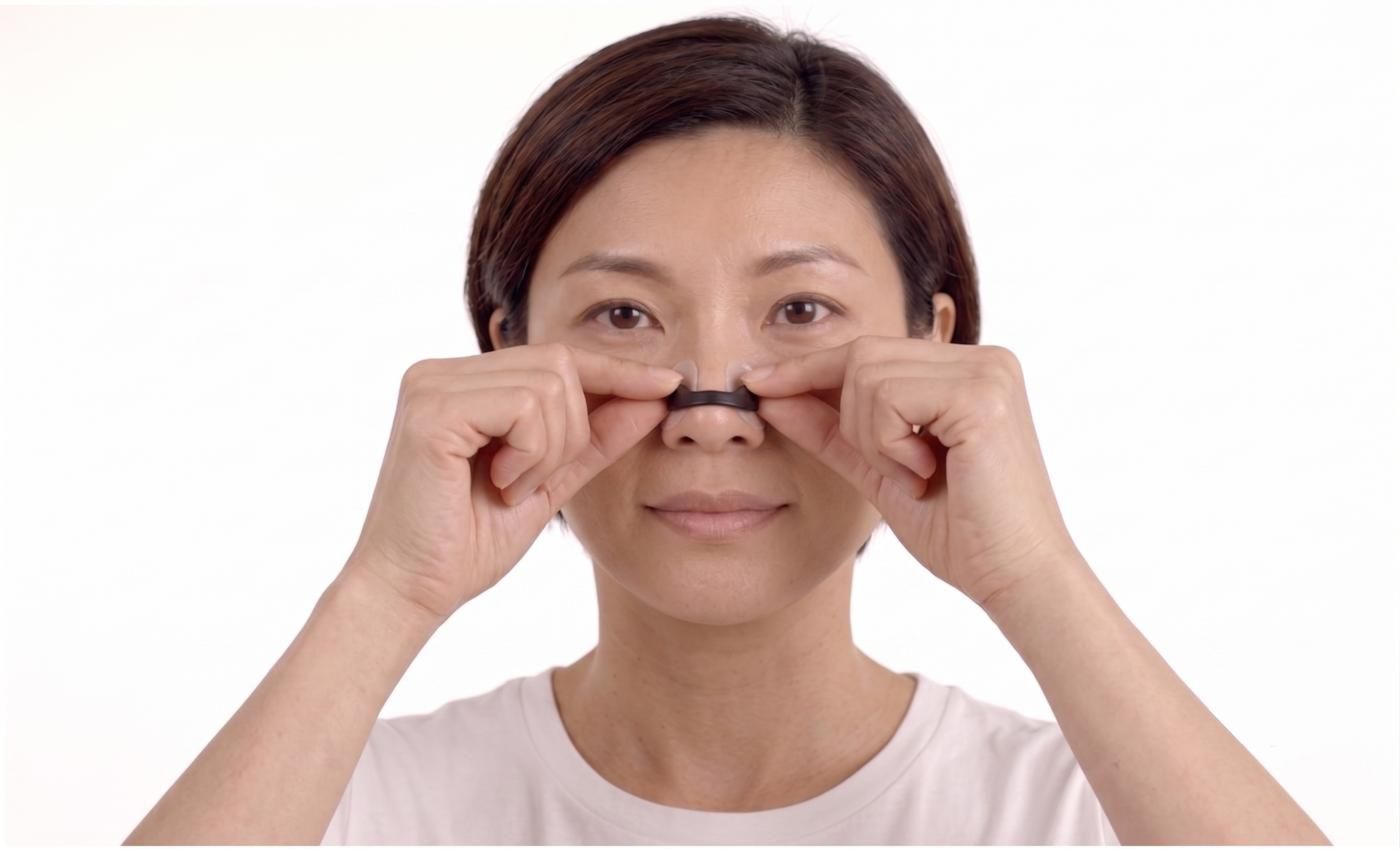
An external dilator holds the nostrils open from the sides while you wear it. There are two main kinds: an adhesive strip that sits across the nose, and a magnetic clip that attaches to two small stickers. The research on them is mixed:
- In a 1999 lab study of 20 adults, a nasal strip raised peak airflow when breathing in hard through the nose by about 12%, by stopping the nostril walls being drawn inwards.[16] That was in healthy adults, awake, breathing in hard.
- In two GSK-funded trials involving 270 adults with night-time congestion, Breathe Right strips didn't improve sleep problems or morning tiredness compared with a dummy strip, though both groups felt better than before the trials began.[17] GSK made Breathe Right at the time.
- In a GSK-funded 2019 study of a prototype strip, the main measure, nasal resistance during sleep, didn't change significantly, and sleep-study results were mostly unchanged. People said they slept better, but there was no dummy strip to compare against.[18]
- In a 2016 study of 100 people with nasal valve problems, two in three wanted to keep using a nasal dilator after a month's trial, and dilators worn inside the nose improved airflow more than external ones. The others stopped because of irritation, poor fit or too little relief.[19]
We could find no published, independent study of any magnetic nasal dilator, including Airlift's. A 2026 review by UK surgeons reached the same conclusion.[20] Our guide to whether magnetic nasal strips work goes into what that means. Our science page lists the studies behind nasal dilators.
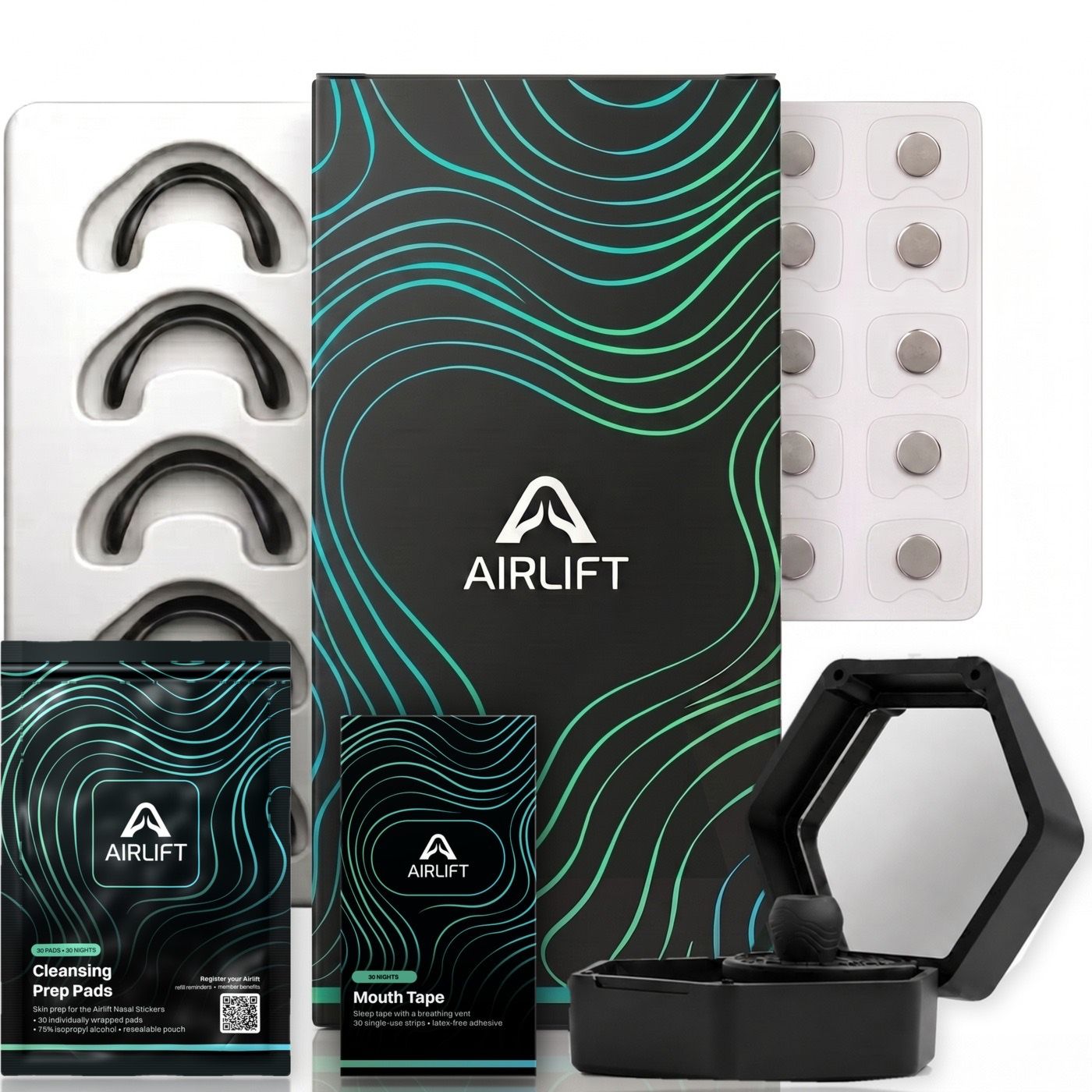
Airlift is a magnetic clip of this kind, which we make. It clips onto two small stickers and holds the nostrils open from the sides. It works only on the outside of the nose, so it can't shrink swollen tissue or clear mucus, and it isn't something to reach for with a cold or an allergy flare.
If you're choosing between a strip and a clip, our comparison of magnetic and adhesive nasal strips sets out the differences.
Questions people ask
References
- Calvo-Henríquez C, Chiesa-Estomba C, Lechien JR, Carrasco-Llatas M, Cammaroto G, Mayo-Yáñez M, Abelleira-Paris R, Gonzalez-Barcala FJ, Martinez-Capoccioni G, Martin-Martin C (2022). The recumbent position affects nasal resistance: a systematic review and meta-analysis. Laryngoscope, 132(1), 6-16. doi.org/10.1002/lary.29509
- Desfonds P, Planès C, Fuhrman C, Foucher A, Raffestin B (1998). Nasal resistance in snorers with or without sleep apnea: effect of posture and nasal ventilation with continuous positive airway pressure. Sleep, 21(6), 625-632. doi.org/10.1093/sleep/21.6.625
- Young T, Finn L, Palta M (2001). Chronic nasal congestion at night is a risk factor for snoring in a population-based cohort study. Archives of Internal Medicine, 161(12), 1514-1519. doi.org/10.1001/archinte.161.12.1514
- Hasegawa M, Kern EB (1978). Variations in nasal resistance in man: a rhinomanometric study of the nasal cycle in 50 human subjects. Rhinology, 16(1), 19-29. pubmed.ncbi.nlm.nih.gov/635366/
- Kahana-Zweig R, Geva-Sagiv M, Weissbrod A, Secundo L, Soroker N, Sobel N (2016). Measuring and characterizing the human nasal cycle. PLoS One, 11(10), e0162918. doi.org/10.1371/journal.pone.0162918
- Rohrmeier C, Schittek S, Ettl T, Herzog M, Kuehnel TS (2014). The nasal cycle during wakefulness and sleep and its relation to body position. Laryngoscope, 124(6), 1492-1497. doi.org/10.1002/lary.24546
- Cole P, Haight JS (1984). Posture and nasal patency. American Review of Respiratory Disease, 129(3), 351-354. doi.org/10.1164/arrd.1984.129.3.351
- Hasegawa M, Saito Y (1979). Postural variations in nasal resistance and symptomatology in allergic rhinitis. Acta Oto-Laryngologica, 88(3-4), 268-272. doi.org/10.3109/00016487909137168
- Värendh M, Janson C, Bengtsson C, Hellgren J, Holm M, Schlünssen V, Johannessen A, Franklin K, Storaas T, Jõgi R, Gislason T, Lindberg E (2021). Nasal symptoms increase the risk of snoring and snoring increases the risk of nasal symptoms. A longitudinal population study. Sleep and Breathing, 25(4), 1851-1857. doi.org/10.1007/s11325-020-02287-8
- Bauchau V, Durham SR (2004). Prevalence and rate of diagnosis of allergic rhinitis in Europe. European Respiratory Journal, 24(5), 758-764. doi.org/10.1183/09031936.04.00013904
- Hastan D, Fokkens WJ, Bachert C, Newson RB, et al (2011). Chronic rhinosinusitis in Europe: an underestimated disease. A GA2LEN study. Allergy, 66(9), 1216-1223. doi.org/10.1111/j.1398-9995.2011.02646.x
- Gray LP (1978). Deviated nasal septum. Incidence and etiology. Annals of Otology, Rhinology and Laryngology Supplement, 87(3 Pt 3 Suppl 50), 3-20. doi.org/10.1177/00034894780873s201
- Ahn JC, Kim JW, Lee CH, Rhee CS (2016). Prevalence and risk factors of chronic rhinosinusitus, allergic rhinitis, and nasal septal deviation: results of the Korean National Health and Nutrition Survey 2008-2012. JAMA Otolaryngology Head and Neck Surgery, 142(2), 162-167. doi.org/10.1001/jamaoto.2015.3142
- Daoud M, Gherasie LM, Fufezan ML, Hainăroșie R, Voiosu C, Rusescu A, Ioniță IG, Aliuș OR, Zainea V (2026). Diagnostic approaches and surgical outcomes in nasal valve dysfunction: a systematic review. Diagnostics (Basel), 16(9), 1324. doi.org/10.3390/diagnostics16091324
- Das A, Spiegel JH (2020). Evaluation of validity and specificity of the Cottle maneuver in diagnosis of nasal valve collapse. Plastic and Reconstructive Surgery, 146(2), 277-280. doi.org/10.1097/PRS.0000000000006978
- Di Somma EM, West SN, Wheatley JR, Amis TC (1999). Nasal dilator strips increase maximum inspiratory flow via nasal wall stabilization. Laryngoscope, 109(5), 780-784. doi.org/10.1097/00005537-199905000-00018
- Noss MJ, Ciesla R, Shanga G (2019). Sleep quality and congestion with Breathe Right nasal strips: two randomized controlled trials. Advances in Therapy, 36(8), 1975-1985. doi.org/10.1007/s12325-019-01005-5
- Wheatley JR, Amis TC, Lee SA, Ciesla R, Shanga G (2019). Objective and subjective effects of a prototype nasal dilator strip on sleep in subjects with chronic nocturnal nasal congestion. Advances in Therapy, 36(7), 1657-1671. doi.org/10.1007/s12325-019-00980-z
- Lekakis G, Dekimpe E, Steelant B, Hellings PW (2016). Managing nasal valve compromise patients with nasal dilators: objective vs. subjective parameters. Rhinology, 54(4), 348-354. doi.org/10.4193/Rhin16.192
- Ahmed A, Gakpetor C, Yang D, Oremule B, Ranganathan B, Jaiswal A, Bhalla RK (2026). The effectiveness of nonsurgical nasal devices in relieving nasal obstruction. Annals of the Royal College of Surgeons of England, 108(6), 476-483. doi.org/10.1308/rcsann.2025.0103

Written by Nicholas Green
I've found it hard to breathe through my nose for as long as I can remember, and years of products and even surgery didn't fix it, so I built Airlift. I write about what I've learned along the way, as someone who lives with it rather than as a clinician.
How we research and check articles: our editorial standards.